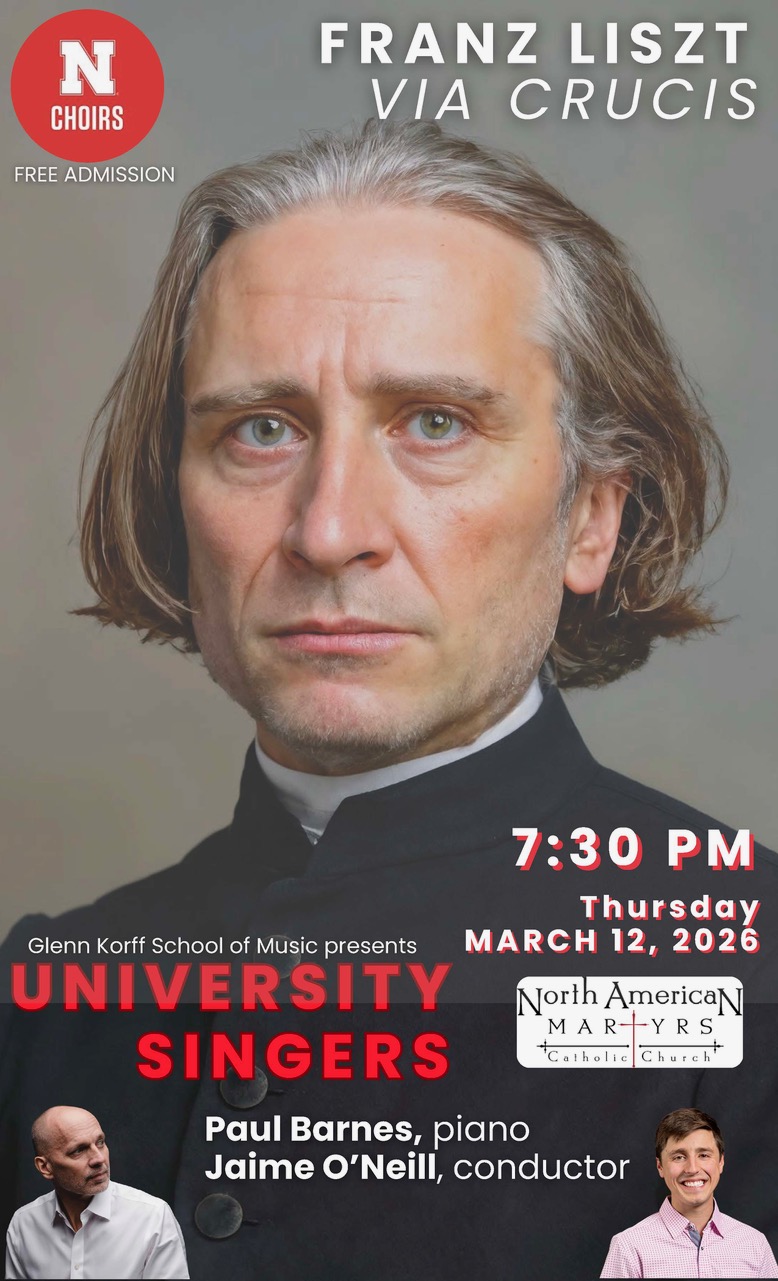
The University Singers and Marguerite Scribante Professor of Piano Paul Barnes will perform “Via Crucis” by Franz Liszt on Thursday, March 12 at 7:30 p.m. at North American Martyrs Catholic Church.
The concert is free and open to the public. The church is located at 1101 Isaac Dr. in Lincoln. The concert will also be live webcast on the church’s YouTube channel.
“Via Crucis,” which is Latin for “Way of the Cross” (also known as the Stations of the Cross), is a work for mixed choir, soloists and organ or piano. It is one of the last works of Liszt and is a work of great serenity.
Yet for all its serenity, Barnes said it’s different from what many listeners expect from Liszt.
“It’s so unusual with the way everybody thinks about what Liszt does and the type of music that he writes,” Barnes said. “But this was written late in his life, and it’s very austere.”
Composed in 1878-1879, “Via Crucis” reflects Liszt’s deep spiritual introspection. Gone are the glittering passages that made him one of the 19th century’s most celebrated pianists. In their place is spare writing built on Gregorian chant, silence and striking harmonic turns that were daring for their time.
Barnes first encountered the work as a graduate student at Indiana University while researching religious symbolism in Liszt’s monumental Piano Sonata in B minor. In an article by scholar Tibor Szasz, Barnes discovered connections between the sonata and “Via Crucis,” particularly the use of musical intervals symbolizing the cross.
“The big deal was Station 11, where Jesus gets nailed to the cross,” Barnes said. “It has these big hammer chords. When I looked at the B minor Sonata, there’s the exact same chord, the exact same key, the same rhythm. Szasz said this has to be symbolizing the crucifixion.”
That discovery sparked what Barnes calls his “love affair” with the piece.
“It is just the purest and most glorious music that Liszt has ever written,” he said. “Within this relatively austere texture, there’s an absolute massive amount of different emotional states communicated in the music — anguish, pain, transcendence, tenderness.”
The score draws on two Gregorian chants, “Crux fidelis” and the “Magnificat,” weaving their intervals into musical symbols of the cross.
“It’s Liszt at his most harmonically daring,” Barnes said. “Some stations are transcendently beautiful. Others are filled with angst and pain. It’s an emotional journey through all 14 stations.”
Barnes is looking forward to performing the piece with University Singers, who will be under the direction of graduate student Jaime O’Neill on “Via Crucis.”
“It’s so wonderful to perform this piece with a choir,” Barnes said.
For O’Neill, the piece has resonated deeply with the University Singers — a 55-voice ensemble composed of students from a variety of faith backgrounds and beliefs.
“This piece has something for everybody. What I’ve found particularly fascinating is that everybody has been able to grasp onto something in it,” O’Neill said. “We have students of different faiths and students without a faith tradition, but everyone has connected to the story in some way.”
“Via Crucis” is not a typical concert piece.
“This is not really a concert,” Barnes said. “It’s a meditation.”
The piece is sung in English, which will heighten its impact and connection.
“We’ll sing a passage in rehearsal and just stop and say, ‘Do you feel that?’” O’Neill said. “And the whole choir has chills. There’s something about understanding every word that brings it straight into your heart.”
The choir takes on multiple roles throughout the piece — the crowd calling for Jesus to be crucified, the women at the cross, even the voice of Christ. Soloists, selected from within the ensemble, will step forward at key moments to heighten the drama.
“It’s powerful to see college students united to tell this story,” O’Neill said. “We always tell our choir we don’t sing to impress — we sing to inspire.”
The setting at North American Martyrs Catholic Church is central to that inspiration. Rather than presenting the work in a traditional concert hall, the work’s impact will be heightened in a sacred space.
“As much as we love the newly renovated Kimball Hall, we’re doing this in a Catholic church because Liszt was a devout Catholic. It’s just the perfect atmosphere,” Barnes said.
The parish has embraced the collaboration. Promotion has extended throughout the Lincoln Catholic community with many clergy expected to attend.
“There’s this wonderful university-community collaboration happening,” O’Neill said. “They are so excited about hosting a university event.”
Barnes also noted an ecumenical dimension. Because the performance falls just before the third Sunday of Lent — dedicated in the Orthodox tradition to the Holy Cross — local Orthodox and Protestant congregations have also shared the event with their communities.
“It’s become this convergence,” Barnes said. “People from different traditions are coming together around this music.”
Barnes will give a pre-concert lecture at 7 p.m., offering listeners key musical motives and symbolic elements to listen for throughout the performance. The printed program will include images of all 14 Stations of the Cross located inside the sanctuary, helping audience members follow the narrative arc.
There are two additional works on the program. The concert opens with “By Night” by Iowa-based composer Elaine Hagenberg and conducted by graduate student Jake Ven Huizen, and also includes “The Word Was God” by Rosephanye Powell, conducted by graduate student Jun Terasawa.
O’Neill said the programming reflects both musical and educational values.
“It’s wonderful to feature living female composers alongside Liszt,” she said. “And it’s exciting that other graduate students get to conduct as well. I think it is outstanding that my mentor Peter Eklund is willing to give up his flagship ensemble for the sake of my experience and learning. That is stellar leadership right there.”
For Barnes, the collaboration itself is a highlight.
“You have world-class faculty collaborating with graduate students,” he said. “That synergy is inspiring. It doesn’t happen everywhere.”
O’Neill agreed.
“Even for me, it’s incredible,” he said. “A few years ago, I would never have dreamed I’d be conducting our top choir in a piece like this with Paul Barnes at the piano. The University Singers are amazing — I could do almost anything, and they’re right there.”
The March 12 performance is a foretaste of a larger celebration of Liszt’s music coming this fall. “Via Crucis” will open the first evening of the upcoming American Liszt Society Festival, scheduled for Sept. 28–30 in Lincoln, hosted by the Glenn Korff School of Music. Barnes is the artistic director for the festival, which will explore chant-inspired works under the theme “Toward Re-enchantment: Beauty as a Portal to the Sacred.” Internationally renowned scholars and performers will join local musicians for concerts, lectures and world premieres.
For Barnes, both the March concert and the festival share a common purpose.
“When human beings encounter beauty, it leads us to something beyond ourselves,” he said. “That’s a psychologically healthy event.”
Barnes hopes audiences come ready for that experience.
“They should expect to be moved. They should expect an emotional journey through all 14 Stations of the Cross,” Barnes said. “It is an amazing journey.”