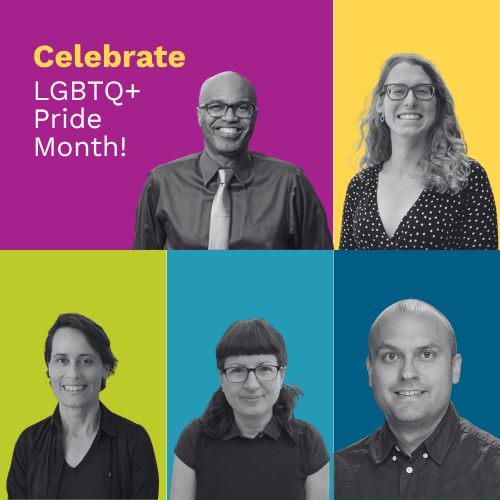
Pride is more than just a month of celebrations and recognition of the LGBTQ+ community. It’s a protest and a fight for liberation. It’s collaboration and support across other marginalized communities. It’s for the future and safety of students, families, teachers and schools.
Check out the following list of resources, curated to help you show support for LGBTQ+ students and bring pride into your mathematics classroom this June and all year long.
Glisten resources for educators and students
Glisten (formerly The Gay, Lesbian, and Straight Education Network [GSLEN]), works to ensure that LGBTQIA+ students are able to learn and grow in school environments free from bullying and harrassment. Glisten offers resources for educators and students.
STEM with pride
In this blog for STEM Education Works, professional learning specialist Chauntee Pitts shares information about STEM trailblazers, why representation in STEM matters, and a hands-on activity in which students can code their own pride messages.
LGBTQ+ Mathematicians posters
Explore the American Mathematical Society's collection of complimentary posters designed to inspire, spark curiosity and celebrate the mathematical sciences. Raise awareness of the beauty of mathematics and exhibit LGBTQ+ pride with its series of posters highlighting LGBTQ+ mathematicians.
Pride events
Throughout June and July, Pride festivals, parades, and other events are happening across the state—like Star City Pride in Lincoln (June 12-13), North Platte Pride (June 21), Kearney Pride (June 27) and Heartland Pride in Omaha (July 17-18). Free Pride 402 is also hosting Pride celebrations in Lincoln (June 27) and Omaha (June 28), organized by community members without corporate sponsors. Many of these events include family-friendly activities and entertainment. Search Facebook events to find Pride celebrations in your area!
About the graphic
The graphic accompanying this story includes images of LGBTQ+ people in the mathematical sciences (clockwise from upper left): mathematics professor and applied mathematics researcher Ron Buckmeier, professor and mathematician Juliette Bruce, STEM education professor and researcher Luis Leyva, professor and number theory researcher Holly Swisher and mathematics, statistics and data science professor Lily Khadjavi.
The University of Nebraska does not discriminate based on race, color, ethnicity, national origin, sex, pregnancy, sexual orientation, gender identity, religion, disability, age, genetic information, veteran status, marital status, and/or political affiliation in its programs, activities, or employment.