Contributed by Laura Weakly, Metadata Encoding Specialist and Chad Koch, Digital Project Specialist, University Libraries
It’s actually 4 blasts from the past that you can now read about on the University of Nebraska-Lincoln Libraries Nebraska Newspapers website.
During World War II, the Naval Ammunition Depot just outside of Hastings, Nebraska produced 40 percent of the Navy’s ordnance for the Pacific theater. Occupying 49,000 acres and employing up to 10,000 workers, this plant produced its own newspaper called the Powder Keg. First published on September 17, 1943, the paper ran weekly throughout the war, with intermittent revivals as a biweekly publication over the ensuing decade.
When, in 1944, the NAD suffered four separate fatal accidents involving exploding ordnance, the Powder Keg kept its commentary on these events minimal. Between the four incidents, 21 workers were killed and dozens more injured, with the largest of these explosions felt in Lincoln 100 miles away.
News coverage of these incidents focused on singling out individuals for bravery while chastising known safety violations (see “ ‘World’s Fastest Women’ Demonstrate Speed”, Powder Keg, August 25, 1944). Much of the news focused on plans to memorialize the lost lives, typically in the form of naming streets at the depot after them (“Streets Named in Memory of Three Seamen”, Powder Keg, October 8, 1943). Beyond the occasion of the explosions, individuals frequently received praise for exceptional efforts made to prevent future such catastrophes.
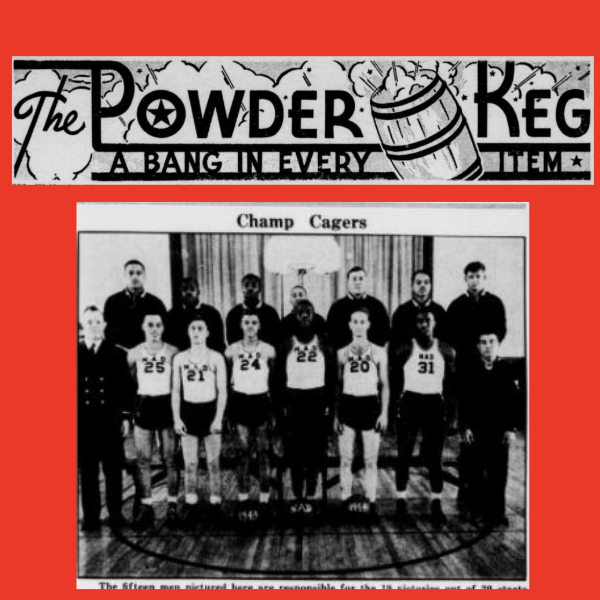
As one of the few places where Black sailors could serve, approximately 1,600 Black sailors, and many more Black civilian laborers, worked at the plant. Tensions between Black sailors and the homogenous populace of Hastings would prove persistent, with the eventual result that sailors looking for rest and relaxation would be bused all the way to Omaha on weekends rather than mingling with the local population. While the depot and the city of Hastings were both officially segregated, news in the Powder Keg suggests that perhaps the lines were not strictly enforced, as seen in sports team's image above ("Champ Cagers," Powder Keg, February 4, 1944).
Joining the Powder Keg’s newly digitized issues on Nebraska Newspapers are The American Citizen, The Beatrice Daily Express, the Cedar County Wachter, The Gordon Journal, Gwiazda Zachodu (The Western Star), The Nebraska Staats-Zeitung, The O’Neill Frontier, The South Omaha Stockman, and The Woman’s Tribune.
These newspapers were part of a National Endowment for the Humanities National Digital Newspaper Program grant for digitization of Nebraska’s historic newspapers. An advisory board of historians, genealogists, librarians, and journalists selected these papers for their historical significance and adherence to our themes for the grant cycle which focused on the World War II era, Suffrage newspapers, and foreign language titles.
Through NEH funding, the UNL Libraries has provided more than 600,000 pages to the Library of Congress’s collection. Other newspapers, including UNL’s campus newspaper The Daily Nebraskan, some Czech language titles, and two Plattsmouth papers have been digitized locally and are available only on Nebraska Newspapers.
To learn more about Nebraska’s new content and some interesting stories across all of our digitized newspapers, please see our series of posts on the CDRH Development Blog. The newspapers are fully searchable on Nebraska Newspapers and incorporated with titles from 53 NDNP participating states and territories at the Library of Congress.