This is the last week of regular classes. Be sure to look to see when and where your finals will take place, as it can be different than your regular scheduled class. Carmen will have academic advising appointments and drop-ins through finals week. May 18th through August 14th there will only be advising appointments, no drop-ins. Carmen will be available throughout the summer to meet with students. Most appointment times will show up about two days in advance. Just let Carmen know if you are needing assistance scheduling an appointment. Have a great summer vacation! Continue reading…
 ACADEMIC ADVISING
Advising appointments are available for meetings via In-Person or Zoom. Visit the Student Success Hub to schedule an appointment with Carmen (you can see your assigned advisor in MyRED or the Student Success Hub). If scheduling an online zoom meeting, the instructions Continue reading…
More details at: https://urldefense.com/v3/__https://unlincoln.my.site.com/SSH/0058W00000BUU5b__;!!PvXuogZ4sRB2p-tU!GsjxtGHg4D10pYD1cWVGOHch0dlv6EzyjF0RDy91RhiF40LewH-5MzGNvcEgp52DJYrPa93e45PhhKcKj4n1Wk_g2ks$
Drop-in advising is great for short 10-15 minute questions about course information, grade option, completing forms and other things of that nature. Students should schedule an academic advising appointment to discuss degree plans and goal setting. Drop-in advising is available via zoom only Continue reading…
More details at: https://cas.unl.edu/drop-in-advising-schedule
Interested in national security?
Ever wondered how religion, identity, and global conflict intertwine?
Debate U.S. foreign policy
Explore the future of international order
Learn cutting-edge theories
ENROLL IN POLS 387 THIS FALL
Continue reading…
Department of Economics Guest Speaker - The Winner Effect
Presented by Dr. Patrick Testa
Tulane University
May 1st, 2026, | 10:00am-11:30am | HLH 219
Elections produce winners and losers, and political actors often treat these outcomes as categorical facts—celebrating victories and mourning defeats regardless of margin. But does finishing first rather than second actually change what follows, independent of how close the race was? This paper argues that it does: electoral wins attract the political investment that produces the downstream gains that justify the signal. I test this using the changing political geography of the United States between 1940 and 1968, when urban and minority areas became increasingly central to the Democratic Party. A regression discontinuity design based on close presidential elections—contests with no direct effect on local offices or policies—shows that counties narrowly won by Democrats saw substantial subsequent gains in Democratic local officeholding and voter support. These shifts stem not from underlying political change but from responses to the binary signal of victory, including increased party advertising, voter outreach, civil rights mobilization, and selective Black in-migration. Effects are concentrated in urban, Black, and union areas, where dense organizational networks amplified the signal and coordinated political investment around it.
Biography Continue reading…
The Center for Global Security Research (CGSR) at the Lawrence Livermore National Laboratory is seeking to hire research associates (RAs) for Fall 2026. The job description and qualifications are on the application site Undergraduate, graduate, and PhD students, along with recent graduates, can apply. The final day to apply is May 30, 2026. Continue reading…
More details at: https://www.llnl.gov/join-our-team/careers/find-your-job/intern/all/3743990012542736
The Irregular Warfare Center (IWC) invites junior scholars to submit papers for the 2026 Irregular Warfare Colloquium, scheduled for Sept. 15-16, 2026, in the Washington, DC area. This selective event will bring together a cohort of 12–14 early to mid-career researchers to present their work on irre Continue reading…
More details at: https://irregularwarfarecenter.org/initiatives/functional-area-networks/
 CAS Career Coaches are available on a drop-in basis Wednesdays and Thursdays, 1-3pm via Zoom or in-person in 107 Oldfather Hall. No appointment needed.
Need more time? Schedule an appointment here.
In addition to helping you with your writing, the writing center also provides accountability appointments! Continue reading…
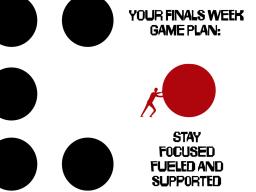 Preparing for finals week isn’t just about studying. It’s also about having a plan to stay focused, manage stress and care for your body. Find practical tips from the University Health Center to help you stay balanced and focused. Continue reading…