By Ronica Stromberg
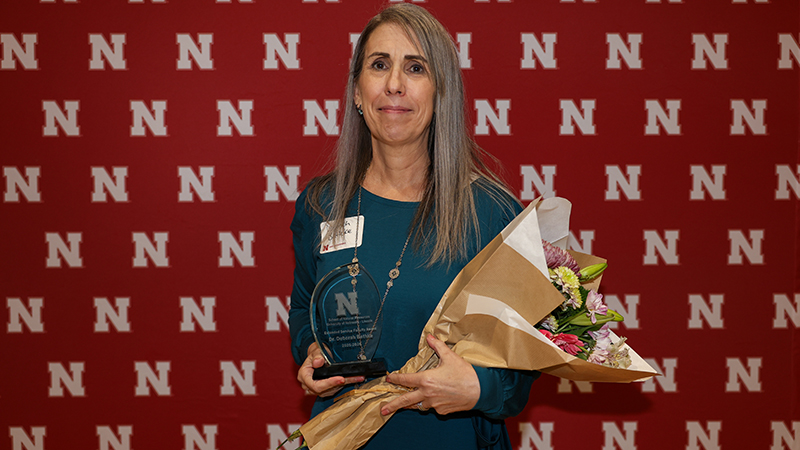
Deborah Bathke, state climatologist, received the Extended Service Faculty Award this year in the School of Natural Resources for her efforts publishing climate findings of the Nebraska State Climate Office in a report. She said the past few years have been rough for climatologists and she found the award really meaningful coming from three nominators.
“Getting recognized for work at a time when people are telling us that the sky is green and the grass is blue, it's important that we stay grounded in evidence,” the University of Nebraska–Lincoln professor said. “At this time, when there's so much mis- and disinformation, any kind of support just helps us carry on.”
To produce the 313-page report, “Understanding and Assessing Climate Change: Preparing for Nebraska’s Future,” Bathke worked with 21 authors. She obtained peer reviews as required by the Nebraska Legislature, which commissioned the report. Besides the University of Nebraska–Lincoln, other universities and colleges that worked on the report were the University of Nebraska Medical Center, Creighton University and Nebraska Indian Community College.
One nominator described Bathke’s work on the project as “a Herculean feat, but also a tightrope walk, and a real risk to put one's name on a document that will surely become a target.”
In the report, which came out in September 2025, Bathke relayed findings about lengthening warm seasons and fewer rainy days or days with snow on the ground. She said days above 80 degrees are coming earlier in the spring and lasting later into the fall. Nebraska’s frost-free season is getting longer, she said, and the state has had about eight fewer days with an inch or more of snow on the ground in 1991 to 2020 as compared with 1951 to 1980.
“The rate of warming has doubled in recent decades,” she said. “Warming is happening everywhere and in every season in the state. The warm season is getting longer or the cold season's getting shorter, whichever way you want to put that, and our extremes are getting more extreme.”
She and Eric Hunt, an extension educator in agricultural meteorology and climate resilience, have been presenting invited talks on the report findings. Bathke delivered the Nebraska Academy of Sciences’ 2026 Maiben Lecture titled “Shifting Extremes: Understanding Nebraska’s Changing Climate and Preparing for What Lies Ahead,” spoke to the Lincoln Garden Club and presented to the School of Natural Resources, among other venues.
“Groups have been interested,” she said. “They are interested in the findings. They're trying to think about what that means, and for what they do and the decisions they make.”
In the report, she suggested ways individuals could combat climate change. These included actions such as converting turf grass to native, drought-tolerant species; composting and using compost in gardens; and, if appliances need to be replaced, replacing them with more energy efficient ones.
She said she and others from the state climate office have also been talking with the City of Lincoln to try to provide information for the city’s climate action plan. She also said they have used information from the report in their research projects, such as one with the community of Niobrara.
“When there's just so much misinformation and disinformation out there about climate and climate change, I think it's important that we have work that was done by scientists from Nebraska, from multiple institutions,” she said. “I think that's important for people to hear it from the people who live and work in the state and not think of it as someone who's sitting off somewhere telling them this information.”
Bathke grew up in Ponca and earned her bachelor's degree in meteorology and climatology and her master’s degree in geosciences from the University of Nebraska–Lincoln. She earned her doctorate in atmospheric sciences from Ohio State University.
She has worked at Nebraska for 18 years and said this was her first award. She had served as a lead author on the prior state climate report, published in 2014. The report has no set timeline for how often it is published.
Mike Hayes, another climatologist and professor at Nebraska, said coordinating the report required significant time and effort and Bathke deserved the award.
“Coordinating this report required bravery, courage, persistence and dedication,” he said. “The amount of pressure that Deb was under as the report was in development is hard to imagine or describe. It would have been much easier to have given up than to continue to the completion of the report. From the beginning, however, Deb insisted that this project would be one that would emphasize the complete portfolio of the expertise that the University of Nebraska and other Nebraska institutions bring to the subject.”