by Fran tenBensel Benne | Agronomy and Horticulture Communication
The Jhala Weed Management Lab in the Department of Agronomy and Horticulture actively participates in two conferences annually — the North Central Weed Science Society meeting and the Weed Science Society of America meeting — and competes in the NCWSS Collegiate Weed Contest. This participation helps graduate students engage with leading weed scientists, present their research, connect with peers and exchange knowledge.
Feb. 9–12, three University of Nebraska-Lincoln graduate students took top honors during the 66th Annual WSSA meeting in Raleigh, North Carolina.
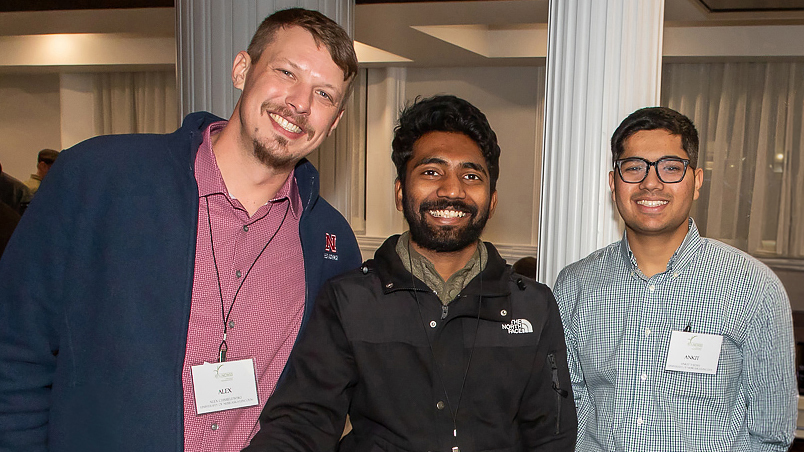
Ankit Yadav, a doctoral student, and Alex Chmielewski, a research technologist and master’s student, both earned second place in different categories of the poster presentation competition. Sai Suvidh Madela, a doctoral student and graduate research assistant, also earned runner-up in the photo contest. All the students work under the direction of Amit Jhala, professor of agronomy and horticulture and Nebraska Extension weed management specialist.
Yadav competed in the Agronomic Crops Section – Ph.D. Division. His poster was titled “Optimization of Rapidicil® Dose and Adjuvant Type for Control of Palmer Amaranth Cheatgrass, Common Ragweed and Kochia.” Yadav presented on Rapidicil® (epyrifenacil), a new postemergence, nonselective Group 14 herbicide from Valent USA for broadleaf and grass weed control, primarily used for burndown prior to planting. In 2025, dose–response studies were conducted in the agronomy and horticulture greenhouse at Nebraska to develop recommendations for application rate and adjuvant use.
“Expanding my professional network was a primary goal in attending, as the WSSA meeting attracts top leaders from both industry and academia,” Yadav said.
Beyond the main conference sessions, WSSA organized multiple industry tours. Yadav chose to visit the Syngenta and BASF headquarters, both of which were highly rewarding and provided valuable insights into the corporate agricultural sector, he noted.
“WSSA features an outstanding graduate student organization,” Yadav said.
The organization hosted several meaningful professional development events, including a scientific writing workshop and a student luncheon that featured a panel of industry leaders discussing emerging technologies in weed management. Yadav served as the organization’s social media chair and is currently serving as vice president.
Chmielewski’s poster was titled “Control of Glyphosate/Glufosinate Resistant Volunteer Corn in Enlist Corn.” He competed in the Integrated Weed Management Section – M.S. Division. His presentation focused on the control of volunteer corn using mechanical methods, herbicide, and a combination of the two at several crop growth stages.
“This research has impact on more than 3.5 million acres of corn-after-corn crop grown annually in Nebraska,” Chmielewski said. “Volunteer corn can reduce crop yields by 14% or more. Enlist corn has a resistance trait to the Quizalofop Group 1 herbicide, giving growers another tool for controlling volunteer corn.”
Chmielewski said the WSSA conference was a great opportunity to discover research topics and developing technologies. Numerous interactive conference events offered opportunities to connect with leading weed scientists and research labs from across the country. Presentations and workshops focused on different research areas available throughout the event.
“I thoroughly enjoyed my experience at the WSSA,” Chmielewski said. “I always find places to eat good food and try to do some sightseeing when time allows. Sharing knowledge and being recognized as an award winner instills a great sense of achievement.”
Maddela competed in the Flowers and Fruit Division of the photo contest. This category involved flowering inflorescences, fruit or seeds of weeds as the main subject of the photo. Maddela entered a photo of curly dock, Rumex crispus L., a perennial herbaceous weed belonging to the buckwheat, Polygonaceae, family. The plant is easily recognized by its tall flowering stalk covered with clusters of small greenish flowers that gradually turn reddish-brown as the seeds mature. Curly dock usually grows about 1-4 feet tall and has long, narrow leaves with distinctive wavy or curled edges, which give the plant its common name.
Maddela also presented two posters, one focusing on the root biology of herbicide-resistant weeds, Palmer amaranth, waterhemp and common lambsquarters, and another poster about the role of a premix microencapsulated Group 14 herbicide in combination with a Group 15 herbicide and its impact on grain sorghum injury, yield and its effect on controlling Palmer amaranth.
“Attending other poster sessions and talks helped me get feedback from experts, which improved my understanding of my own research,” Maddela said. “I also found the networking opportunities, especially through our WSSA Graduate Student Organization, helpful in building contacts that could lead to collaborations or future career opportunities.”
Not only was this a proud moment for the Jhala Lab, but Maddela was greatly honored to represent the University of Nebraska-Lincoln and the agronomy and horticulture department on such a huge platform.
“The WSSA meeting was informative, inspiring and very relevant to my research in weed science,” Maddela said.
According to the students, the WSSA conference was a highly rewarding experience overall. They thoroughly enjoyed the meeting and the vibrant culture of Raleigh and look forward to next year’s conference in Denver, Colorado.
Beyond academic conferences, the Jhala Lab is highly engaged in community and industry outreach. They participate in the IANR Discovery Days and tailgates, and host an annual field day for growers, where cutting-edge weed-management technology is displayed at the South Central Agricultural Laboratory in Clay Center, Nebraska.
More photos at https://go.unl.edu/k3r0.
More details at: https://go.unl.edu/k3r0