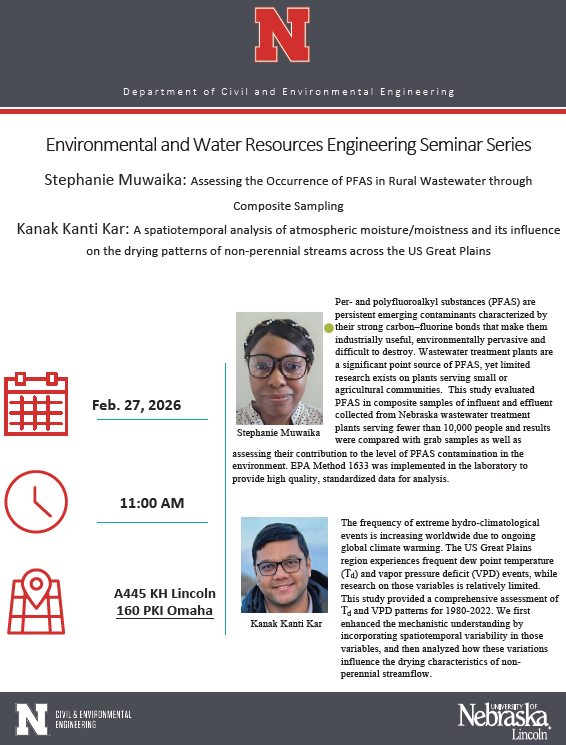
Speakers: Stephanie Muwaika and Kanak Kanti Kar
When: Feb. 27, 2026, 11:00AM
Where: KH A445 (Lincoln) PKI 160 (Omaha)
Stephanie Muwaika: Assessing the Occurrence of PFAS in Rural Wastewater through Composite Sampling
Abstract: Per- and polyfluoroalkyl substances (PFAS) are persistent emerging contaminants characterized by their strong carbon fluorine bonds that make them industrially useful, environmentally pervasive and difficult to destroy. Wastewater treatment plants are a significant point source of PFAS, yet limited research exists on plants serving small or agricultural communities. This study evaluated PFAS in composite samples of influent and effluent collected from Nebraska wastewater treatment plants serving fewer than 10,000 people and results were compared with grab samples as well as assessing their contribution to the level of PFAS contamination in the environment. EPA Method 1633 was implemented in the laboratory to provide high quality, standardized data for analysis.
Kanak Kanti Kar: A spatiotemporal analysis of atmospheric moisture/moistness and its influence on the drying patterns of non-perennial streams across the US Great Plains
Abstract: The frequency of extreme hydro-climatological events is increasing worldwide due to ongoing global climate warming. The US Great Plains region experiences frequent dew point temperature
(Td) and vapor pressure deficit (VPD) events, while research on those variables is relatively limited. This study provided a comprehensive assessment of Td and VPD patterns for 1980-2022. We first enhanced the mechanistic understanding by incorporating spatiotemporal variability in those variables, and then analyzed how these variations influence the drying characteristics of nonperennial streamflow.