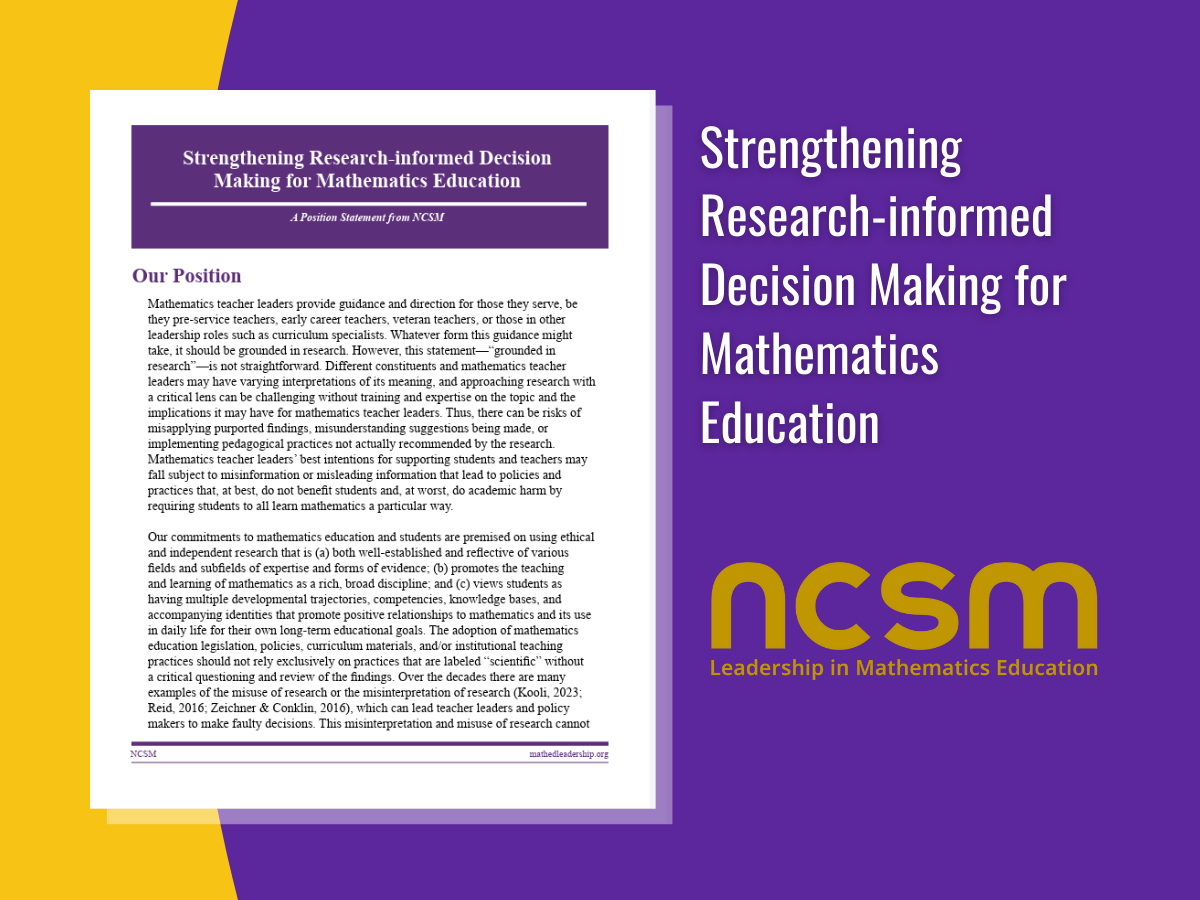
The National Council of Supervisors of Mathematics (NCSM) has a new position paper on "Strengthening Research-informed Decision Making for Mathematics Education."
Mathematics teacher leaders provide guidance and direction for those they serve, be they pre-service teachers, early career teachers, veteran teachers, or those in other leadership roles such as curriculum specialists. Whatever form this guidance might take, it should be grounded in research. However, this statement—"grounded in research"—is not straightforward. Different constituents and mathematics teacher leaders may have varying interpretations of its meaning, and approaching research with a critical lens can be challenging without training and expertise on the topic and the implications it may have for mathematics teacher leaders. Thus, there can be risks of misapplying purported findings, misunderstanding suggestions being made, or implementing pedagogical practices not actually recommended by the research. Mathematics teacher leaders’ best intentions for supporting students and teachers may fall subject to misinformation or misleading information that lead to policies and practices that, at best, do not benefit students and, at worst, do academic harm by requiring students to all learn mathematics a particular way.
NCSM's commitments to mathematics education and students are premised on using ethical and independent research that (a) is both well-established and reflective of various fields and subfields of expertise and forms of evidence; (b) promotes the teaching and learning of mathematics as a rich, broad discipline; and (c) views students as having multiple developmental trajectories, competencies, knowledge bases and accompanying identities that promote positive relationships to mathematics and its use in daily life for their own long-term educational goals. The adoption of mathematics education legislation, policies, curriculum materials and/or institutional teaching practices should not rely exclusively on practices that are labeled "scientific" without a critical questioning and review of the findings. Over the decades there are many examples of the misuse of research or the misinterpretation of research (Kooli, 2023; Reid, 2016; Zeichner & Conklin, 2016), which can lead teacher leaders and policy makers to make faulty decisions. This misinterpretation and misuse of research cannot persist. NCSM: Leadership in Mathematics Education calls for all mathematics teacher leaders, no matter their role, context, or years of experience to take a stand against the misapplication of research.
Download the entire position paper [PDF].