By Ronica Stromberg
The High Plains Regional Climate Center at the University of Nebraska–Lincoln received $377,002 in added funds from the National Oceanic and Atmospheric Administration October 1 to upgrade tools, engage with partners and use artificial intelligence to ensure data quality.
Rezaul Mahmood, director of the center, said he found the inclusion of artificial intelligence in the center’s work to be particularly interesting. He and his six-member staff have been exploring using AI to ensure the quality of climate data used in tools on the center website. For example, if they are missing data on temperatures and precipitation for a day, they can use AI methods to estimate and fill in the missing data.
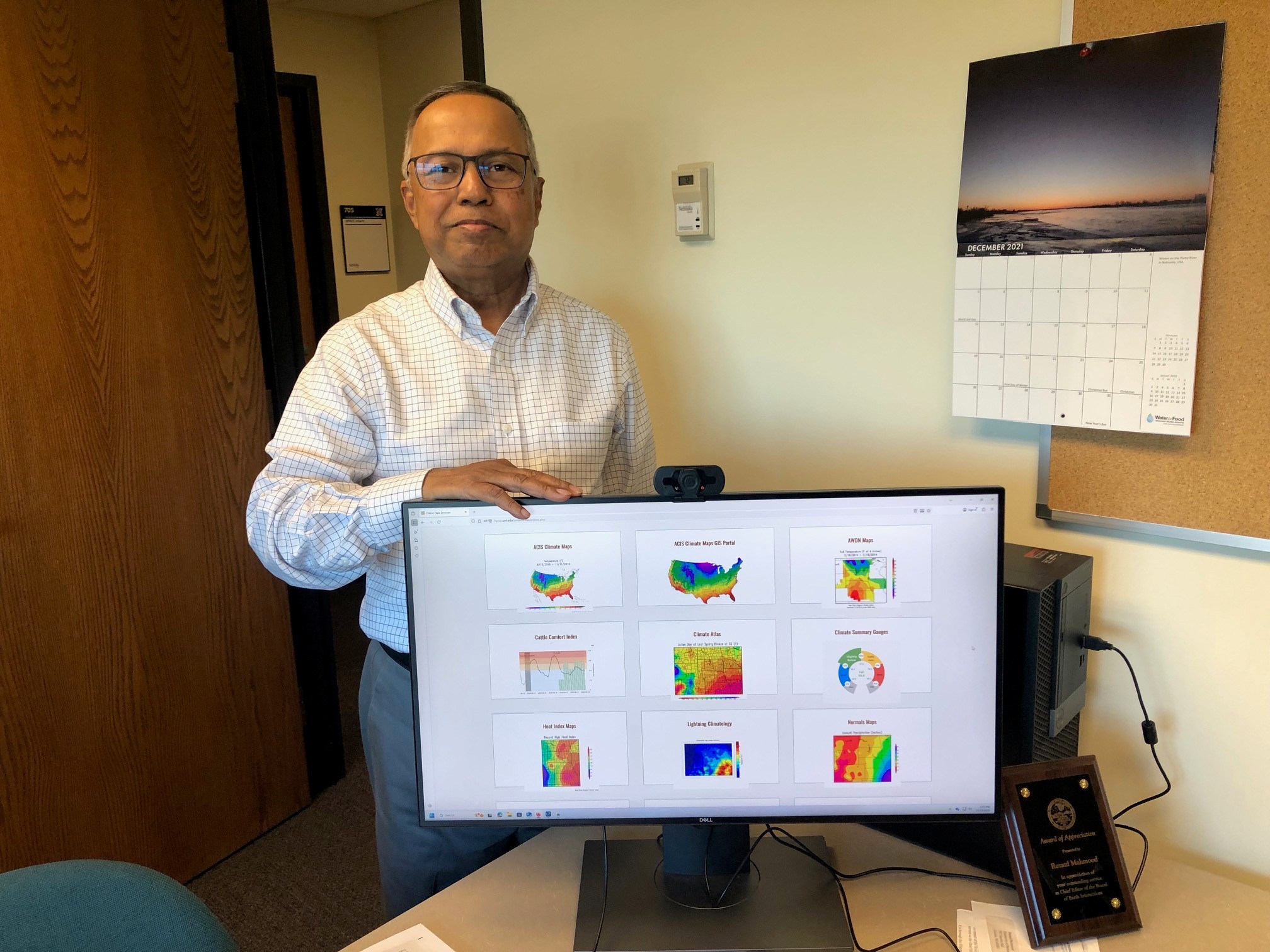
They use climate data from the National Centers for Environmental Information to develop website tools the public uses in making decisions. Users are as varied as farmers deciding when to plant or irrigate, government workers managing reservoirs and stockbrokers evaluating markets. The center develops tools at the request of users or based on interest shown by them, Mahmood said.
“It's always an ongoing process, so we are never in one spot,” he said. “We are always moving and doing newer things, because the requests come. And not only that, when you develop a tool, then people request new features.”
Center staff members organize activities like workshops to reach out to partners and learn of other needs to address with the climate tools. They will use some of their latest federal funding to support these engagement activities and continue improving tools to respond to needs.
Tools recently launched or upgraded include the CliGrow Tool, formerly named the Growing Degree Day Tool. Farmers use the tool’s graphs to see historical data on growing stages of crops and make decisions like when to plant, apply fertilizer or pesticides and hire labor to work in the fields. That tool once showed only corn data but now offers data on 10 crops.
The Water Deficit Trends Tool monitors dryness and wetness across the region. When users wanted to compare this map with the U.S. Drought Monitor and other maps, the center offered a new feature where users could lay other maps over it.
The Cattle Comfort Index, built at the request of producers, graphs temperatures and precipitation throughout the year and indicates stress on cattle. The Nebraska Mesonet provides the meteorological data for this tool and another center tool calculating evapotranspiration for irrigation.
When the USDA Forest Service requested a tool to look at wind and hazardous days for spreading fire, the center developed the Wind Climatology Tool.
In all, the website holds about 30 tools and receives about 115,000 visits per year. The tools staff members create often go beyond the region, which includes Colorado, Kansas, eastern Montana, Nebraska, North Dakota, South Dakota and Wyoming.
“About half of our tools are for the national scale because when we develop something, we are good at it and can expand it to the entire country,” Mahmood said.
Darren Clabo, South Dakota’s fire meteorologist, said he uses many of the center’s products to assess wildfire risks.
“The ACIS Climate Maps are especially helpful to understand temperature and precipitation departures from normal, which allows me to better predict where wildland fuels may be stressed and more susceptible for large fire growth,” he said. “Furthermore, the Climate Patterns Viewer helps me to build my seasonal wildfire potential outlooks based upon the current and predicted ENSO [El Niño/Southern Oscillation] state.”
Larkin Powell, the director of the university’s School of Natural Resources where the High Plains Regional Climate Center has been headquartered for nearly 40 years, said the center has been a boon to Nebraska and people across the country. He credited the hard work of the center’s staff in keeping the center relevant to the public’s needs.
"Communities, ag producers and residents of our region are asking for tools to make decisions in the face of severe rain, drought and wind events," he said. “It is a privilege for the University of Nebraska and the School of Natural Resources to host this unique center that is engaged with the public.”