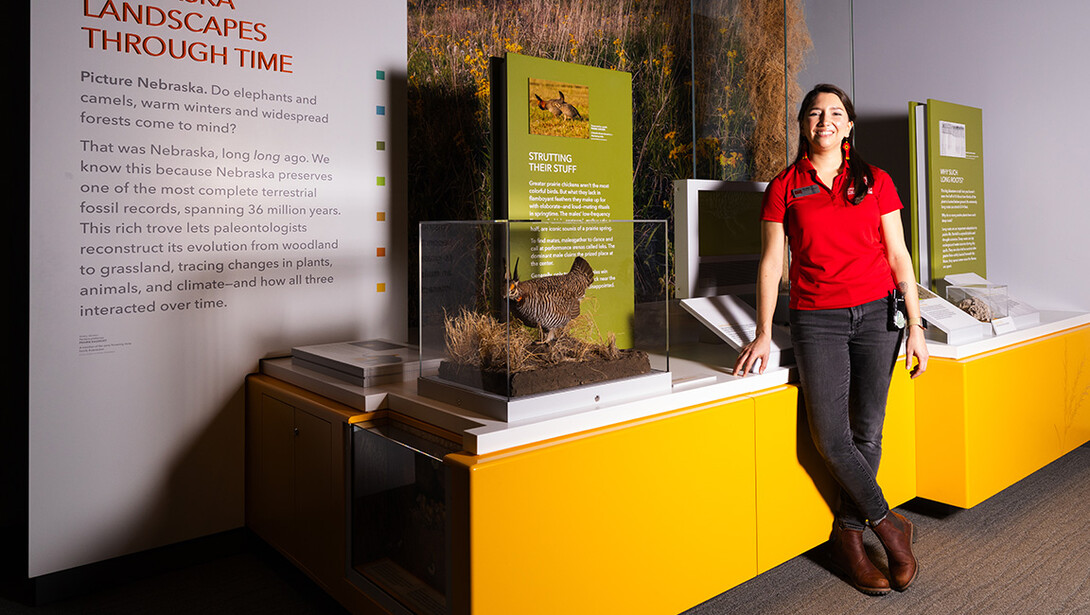
By Deann Gayman | University Communication and Marketing
One could say Nebraska’s deep prairie roots helped Ann Spilker find her wings.
As an undergraduate studying organismal biology, she thought grad school and research were her career path. A person who enjoyed the outdoors, she didn't think she'd end up working with people, and instead imagined a life surrounded by animals, data and field notes.
“But there wasn’t a specific thing I was really fascinated by or felt a passion for,” she said.
She earned her bachelor’s from Concordia University, but pressed pause on graduate school. Instead, she took a job at Pioneers Park Nature Center. Out on the prairie, talking with visitors and leading camps, her purpose came into focus.
“I realized I like working with people,” said Spilker, now the extended learning coordinator with the University of Nebraska State Museum. “I had all this knowledge to share and felt how important it was to help people care about it. We’re out on the prairie, and these are such important ecosystems, but there’s only about 2% of prairie left in Nebraska. The roots are 15 feet deep. They literally hold the ground together. There’s no way people are going to know or care unless you have educators communicating that message.”
Those conversations — often with children, outside and in the grass — redirected her career. She returned to graduate school at the University of Nebraska–Lincoln, earning a master’s degree in natural resource sciences with a specialization in human dimensions, the closest program she could find to environmental education.
Meanwhile, a temporary position with Nebraska Game and Parks as a naturalist and educator at both Platte River State Park and Schramm State Park was wrapping up, and Spilker saw a job opening at the University of Nebraska State Museum.
“The whole reason I kind of got hired was to create the camp program,” she said. “Before I came on, they did day camps, but only two or three weeks in the whole summer, whenever staff had time to squeeze them in.”
Spilker saw an opportunity to reshape what learning could look like for kids exploring everything the museum had to offer. Taking the helm in October 2023, Spilker led the first Discovery Day Camp in March 2024 during Lincoln Public Schools’ spring break.
“We created Discovery Day Camp and branded it that way because we want kids to be curious and excited about learning and exploring Nebraska’s natural history, being outdoors, observing things about the world,” she said.
That first year, she worried not enough families would sign up. But most camps had 10–15 excited young naturalists — the perfect size for a piloting the new programs. Since then, interest and participation have increased each year, and based on inquiries via email and phone, she expects this summer to be the most well-attended yet. Registration is open now.
“We’re still experimenting to figure out which topics and structures work best,” she said. “But after two years, I feel like we’ve really started to hit our stride.”
The 18 camps offered throughout the summer now incorporate field trips, guest visits from experts such as wildlife biologists or scientific illustrators, and plenty of time outside, even in urban green spaces.
“I try to emphasize with the kids that nature is all around,” she said.
With the Discovery Day Camps running, Spilker is adding programs. She recently started an afterschool club and piloted a museum overnight event with scouting groups that she hopes to offer to the general public in the near future.
Though she leads the operation, Spilker credits her colleagues for helping shape camp themes and activities.
The heart of her work, though, still traces back to that early realization on the prairie: education is how people learn to care.
“There’s so much wonder in the natural world,” she said. “Helping kids notice that — helping them connect with it — that’s what keeps me going.”
More details at: https://news.unl.edu/article/spilker-plants-seeds-of-discovery-for-museum-campers