By Kristina Jackson | University Communication and Marketing
Decades ago, some streets in Lincoln were planted with lines of new ash trees. Now, professionals like foresters and arborists recognize the need to diversify tree selection to protect from species-specific diseases or pests like the emerald ash borer.
This is just one example of guidance Nebraska towns receive from University of Nebraska–Lincoln experts to create more robust community forests.
“Now, that whole street of trees is getting removed at once because they’re getting infected,” said Hanna Pinneo, executive director of PlantNebraska, formerly the Nebraska Statewide Arboretum. “All of a sudden, people walk out their front door or out of their business or their school, and it’s a stark reminder of what they were benefiting from.”
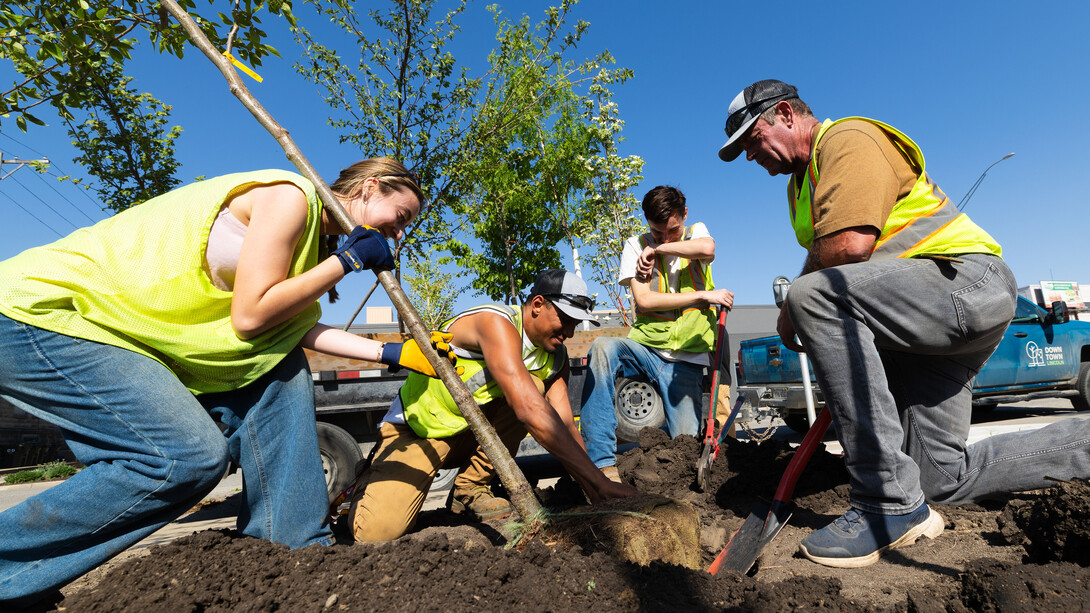
Various University of Nebraska–Lincoln agencies collaborate with Nebraska communities to combat tree loss. From planning to planting to care, they are helping towns grow a better, healthier future together through better care of trees.
“Our roads need maintenance, our sidewalks need maintenance, our trees need maintenance,” Pinneo said. “For a long time, we’ve taken trees for granted … We need to look at trees like we look at any other infrastructure. They’re vital to our communities; they should be managed the same way.”
Nebraska leads the country in community tree canopy loss, a phenomenon largely caused by aging trees, drought, severe weather and disease. Organizations like the Nebraska Forest Service, PlantNebraska and the School of Natural Resources are approaching the issue from many directions: education and workforce development, planning and data, and grant funding for planting and removal projects.
“Our trees were, thankfully, planted by somebody who cared, but they’re aging out,” said Christina Hoyt, assistant forester and bureau chief for community landscape and forest health. “We have more limited tree species makeup in a lot of our communities.”
The community canopy refers to trees planted along streets, in parks and on other public lands. These trees help manage stormwater, erosion and air pollution, provide shade and physical and mental health benefits for people, and even have economic benefits by making business districts more attractive.
“Especially as we see whole streets of trees disappear, you’re going to see your community change, and maybe not in a way you want to see it change,” Pinneo said.
There is an urgency to start planting trees as soon as possible, but Hoyt said it is also crucial to do this correctly. Towns must plant the right species in the right place to maximize benefits and get the most longevity from the trees.
“We can make sure we’re planting trees behind them so we have the next generation there for the future,” Hoyt said. “There’s probably not enough tree planting happening for the scale of loss we’re seeing … We need to get those trees back in place so they can start to provide those benefits. Some of those benefits are going to be realized the day they’re planted, and other benefits decades later.”
See the full story at https://news.unl.edu/article/university-efforts-bolster-nebraskas-community-tree-canopy