There are so many remarkable NCESR success stories to share that we continue to feature these inspiring accounts from our faculty and students in place of the traditional Director’s Corner article.
With nearly two decades of sustained funding support from NPPD, NCESR has been a catalyst for impactful research seed funding in the energy sciences. This longstanding partnership has enabled NCESR to provide critical seed funding that has supported numerous UNL faculty members, created valuable opportunities for students, and led to a strong record of publications and citations. Most notably, the return on investment has been exceptional — with every $1 of NCESR seed funding generating an impressive $8.61 in external research funding.
We are proud of these achievements and look forward to the future. NCESR has begun the Cycle 21 selection process, for seed funding, continuing our commitment to advancing energy research and innovation.
Dr. Craig Zuhlke’s success is presented below.
NCESR Support as a Catalyst for Laser-Based Surface Functionalization and Heat Transfer Research
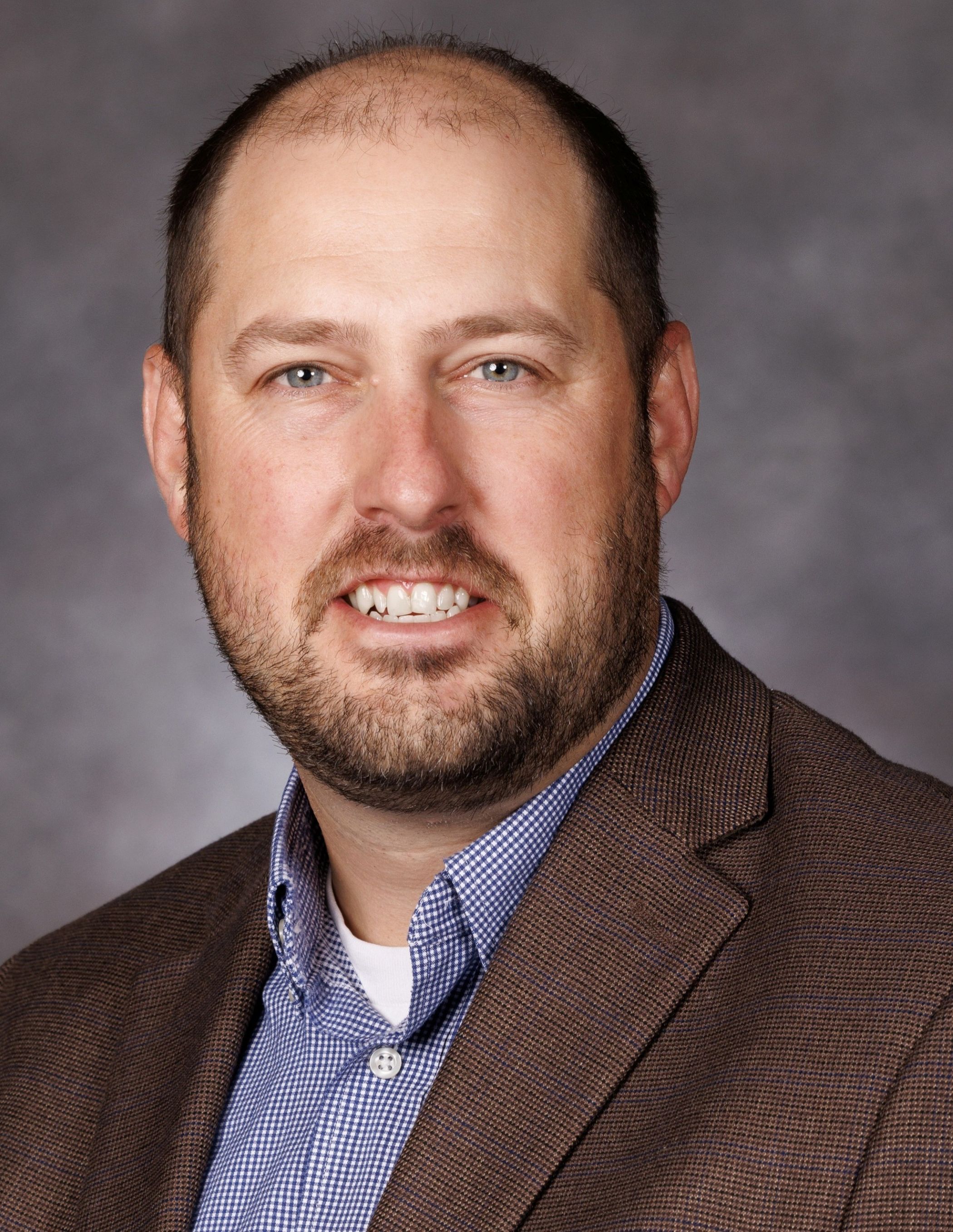
Dr. Zuhlke, Richard L. McNeel Associate Professor of Engineering, Electrical & Computer Engineering.
During my third year as an electrical engineering student at the University of Nebraska–Lincoln (UNL), I had an experience that would change the trajectory of my career in ways I never could have anticipated: I was introduced to the world of lasers. I owe a tremendous debt of gratitude to Professor Dennis Alexander, who not only introduced me to laser science, but also inspired my academic career. Since that moment, the only thing greater than my fascination with lasers has been my obsession with how they can be used to permanently alter materials and enable new functionality.
The Nebraska Center for Energy Sciences Research (NCESR) has had a significant impact on the evolution of that interest into a sustained research program. Beginning during my time as a PhD student at UNL, NCESR played a formative role in shaping the direction of my work. Two NCESR-funded projects during Cycles 6 and 8 not only supported specific technical advances, but also served as a critical bridge between my doctoral dissertation research and a long-term, interdisciplinary effort focused on laser-functionalized surfaces, with a growing emphasis on addressing heat transfer and thermal management challenges.
My doctoral research focused on the fundamental interactions between ultrashort pulse lasers and materials. That work resulted in four publications that formed the basis of my dissertation and demonstrated how Self-Organized Laser Functionalization (SOLF) can be a scalable single-step process to create permanent micro- and nano-scale surface structures while simultaneously altering surface and subsurface chemistry, microstructure, and porosity. While the early work was largely fundamental in nature, it revealed clear potential for functionalizing surfaces in ways that could directly impact fluid interaction, wetting behavior, and heat transfer. The NCESR projects represented an important next step in translating these fundamental discoveries into energy-relevant applications.
The first NCESR project, funded during Cycle 6, was titled Enhanced Hydrogen Electrolysis and Heat Transfer Using Micro/Nano Structured Surfaces and was led by my graduate advisor Professor Dennis Alexander, with Professor George Gogos as Co-PI. As a PhD student, I contributed to proposal development and was involved in the experimental research as a postdoc. While the project examined electrolysis performance, the more lasting impact of this work was the insight it provided into how laser-structured surfaces influence bubble dynamics and two-phase heat transfer. NCESR support allowed us to investigate how surface morphology affects vapor generation, bubble departure frequency, and liquid replenishment; mechanisms that are central to boiling heat transfer and thermal management systems.
A key outcome of the Cycle 6 project was the establishment of a collaboration between our laser processing group and Professor George Gogos, whose expertise in heat transfer and fluid mechanics added essential depth to the work. This collaboration marked a turning point, shifting the focus of laser surface processing from primarily surface physics to include a broader role in thermal-fluid systems. NCESR funding made it possible to connect experimental laser fabrication with heat transfer characterization, laying the groundwork for more advanced and application-driven research.
My research as a postdoc included expanding both the experimental capabilities and the scope of materials and thermal environments studied. This progression led directly to the Cycle 8 NCESR project, Numerical Modeling of the Formation of Micro/Nanostructures on Metals Using Femtosecond Laser Surface Processing, with Professor Gogos serving as principal investigator. I again contributed to proposal writing and research execution.
Cycle 8 shifted emphasis from application demonstrations to a deeper understanding of the formation mechanisms of SOLF surfaces. Predictive modeling of ultrafast laser–matter interaction, melt dynamics, and structure evolution is essential for developing surfaces optimized for heat transfer and other applications. NCESR support enabled the development of modeling tools that complemented experimental studies and provided a framework for systematically tailoring surface features for thermal-fluid performance.
These Cycle 6 and Cycle 8 projects served as the foundation for subsequent large-scale efforts. The NCESR-supported collaboration directly contributed to development of a NASA EPSCoR proposal for a project on biomimetic micro- and nano-structured SOLF surfaces for thermal management, where I began as a postdoc and later transitioned into a faculty role. That effort, in turn, helped establish a well-funded, multidisciplinary team working on two-phase heat transfer, microchannel flow-boiling, and advanced thermal systems. The NCESR and NASA projects led to a major research program supported by the Office of Naval Research (ONR) that has been ongoing over the past decade with several research and equipment grants.
Today, this research has grown into sustained programs on developing SOLF and research into many different applications supported by many sources including ONR, NASA, NSF, DOE, industry, and recently a DARPA effort focused on thermal management for three-dimensional heterogeneous integration of electronic microsystems. As an outcome of the early NCESR support and in response to the interdisciplinary growth, the Center for Electro-Optics evolved into the Center for Electro-Optics and Functionalized Surfaces (CEFS). This transition of the center to the current CEFS reflects how laser-based surface functionalization has become a core capability for addressing many challenges that require advanced surface modifications across energy, aerospace, and defense applications. I now serve as a co-director of CEFS, along with Prof. Gogos. Today CEFS includes involvement by about 30 faculty, postdocs, graduate and undergraduate students at UNL as well as collaborators at a number of other universities, national labs, NASA labs, and companies.
At the time of the initial NCESR support, the research relied on research-grade low power femtosecond lasers that required daily tuning to keep operational. The past few years have been really exciting with developments by the laser industry of new high power and stable femtosecond laser systems that have the unique combination of high energy pulses at high repetition rate that is now enabling scale-up of SOLF. These new lasers, which CEFS is one of the leaders in implementing in a research lab, are expanding the scope of ongoing SOLF research and creating new pathways toward commercial applications.
From my perspective, NCESR played a uniquely important role at a pivotal stage. It provided the support needed to move beyond basic research focused on laser-matter interactions, establishing lasting collaborations, and demonstrating the relevance of laser-functionalized surfaces in energy and thermal management systems. These developments have had broader implications for SOLF research in CEFS expanding to many other areas including anti-microbial surfaces, surfaces to enhance bonding, drag reducing surfaces, anti-icing surfaces, and broadband absorbing and high emissivity surfaces. The long-term successes that followed can be traced directly back to the momentum generated by those early NCESR projects.