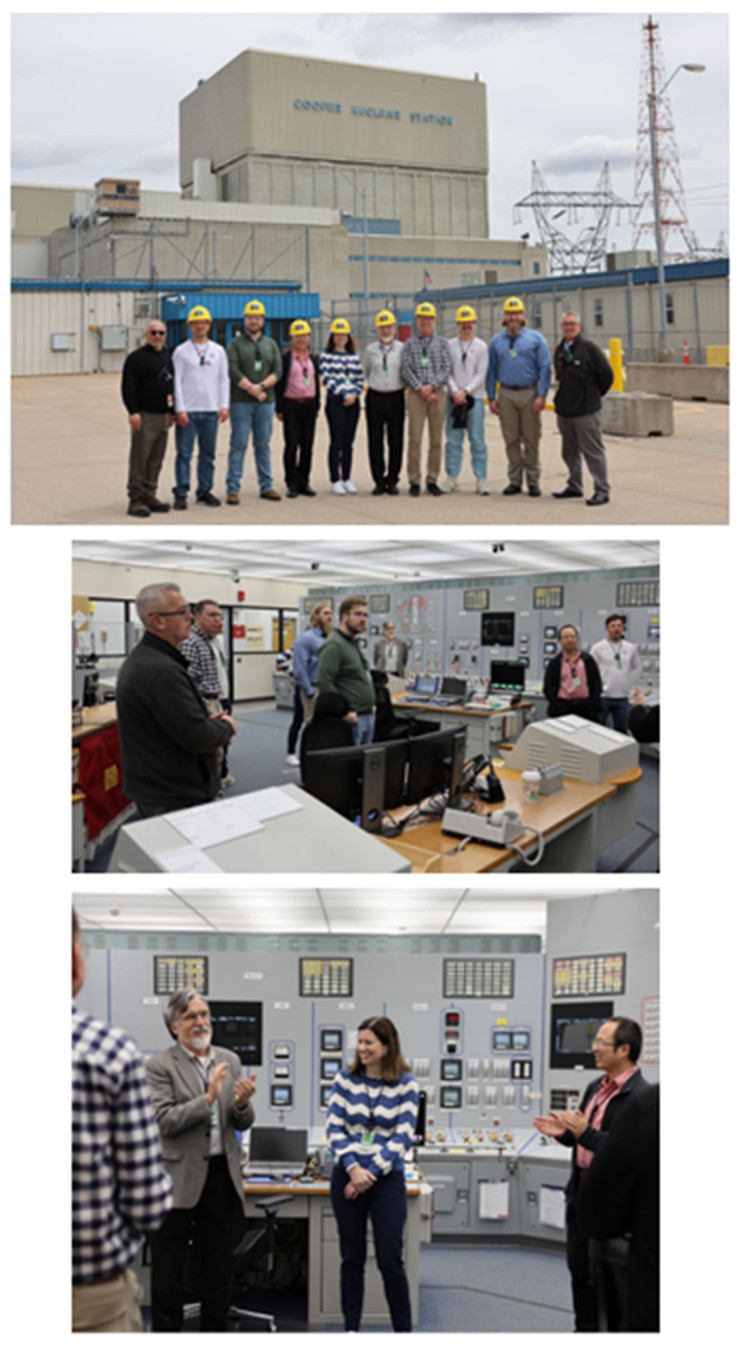
Leadership from the University of Nebraska–Lincoln and the Nebraska Center for Energy Sciences Research visited Nebraska Public Power District's Cooper Nuclear Station (CNS) on May 6 for an inside look at how nuclear power supports Nebraska’s energy needs — today and in the decades ahead.
The tour was led by John Dent, executive vice president and chief nuclear officer; Khalil Dia, site vice president; and Justin Reimers, general manager of plant operations. The group explored several key areas of the facility, including the Control Room, the Reactor Building’s refuel floor, the Turbine Building, the switchyard, and the Independent Spent Fuel Storage Installation.
Among the highlights was an interactive demonstration in the Control Room Simulator, where visitors could see firsthand how operators monitor plant conditions and respond to changing scenarios. The group also witnessed new fuel arriving on-site and being transported to the refuel floor in preparation for the plant’s upcoming refueling outage this fall.
Throughout the visit, CNS leaders shared insights into the station’s history, discussed how a boiling water reactor generates power, and outlined the value of Nebraska’s existing power generation assets. Conversations also focused on the future of nuclear energy in the state, including long-term planning and industry innovation.
In 2024, CNS celebrated 50 years of commercial operation. During that timeframe, CNS generated an estimated 275 million megawatt-hours of carbon-free electricity — avoiding roughly the same number of tons of carbon dioxide emissions.
This year marks another important milestone. The plant’s current operating license, renewed by the Nuclear Regulatory Commission (NRC) in November 2010, extends to January 2034. In February 2024, the Nebraska Public Power District board of directors voted to pursue a subsequent license renewal that would allow the station to operate for an additional 20 years, through 2054, if approved. CNS submitted its application to the NRC earlier this month.
With decades of clean energy production already behind it — and the potential for many more ahead — CNS continues to play a vital role in meeting Nebraska’s energy needs while supporting research, innovation, and economic growth across the state.