By Ronica Stromberg
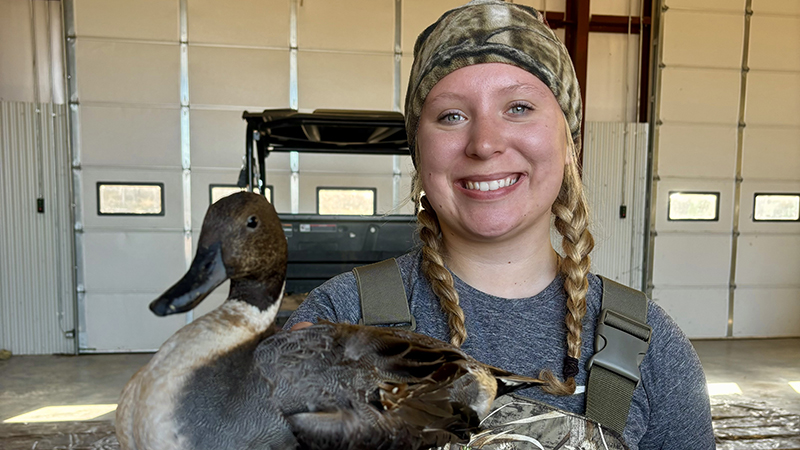
When Ava Britton left Connecticut to move to Nebraska to conduct duck research there and in South Dakota, her family and friends questioned her, "Why Nebraska?" It was a question she was asking herself, a fan of large, charismatic animals like deer and bears—not ducks.
Still, when University of Nebraska–Lincoln professors Mark Vrtiska and Chris Chizinski offered her support for master's research on how new regulations might affect duck hunting, she took it.
Britton soon found answers in the duck research—and for the friends who questioned her state choices. She invited them to Lincoln. They came and saw for themselves why Nebraska.
"They were really surprised by how nice Lincoln is and how nice Nebraska is in general," she said. "But yeah, I really love it out here, and I would definitely be happy staying for a bit longer."
Since fall 2024, she has been studying two-tier hunting regulations piloted in Nebraska and South Dakota in March 2021. Under the original duck hunting regulations, Tier I, hunters can harvest six ducks a day but the ducks have to be of a specified species or sex. Under Tier II regulations, hunters can harvest three ducks a day without species or sex restrictions.
Britton and Maddy Vasquez, another master's student, have found through hunter surveys that harvest patterns remain about the same under Tier II as under Tier I.
"That was one of the big concerns at the beginning of implementing these regulations was, are people going to take advantage of the easier regulations to shoot more of a certain species of duck and is that going to affect the populations in a way that we don't want it to? And we really haven't been seeing that," Britton said.
She has presented her findings at waterfowl conferences and meetings of The Wildlife Society and of the Central Flyway Council. Often, she has been the only woman in a room full of men in their 50s, she said.
"It can be really intimidating, especially when I first started out as, like, 'Oh, I should not have a voice here. They don't want to hear from a 23-year-old master's student.' But I've made so many friendships and connections through all of those moments, and it's really changed my perspective,” she said. “I think women are starting to really get a foot in waterfowl, which is great to see, and I really want to continue in waterfowl research."
Read the rest of Ava's story and see more images at
https://snr.unl.edu/aboutus/what/newstory.aspx?fid=1347