Scholar: Qu Wen
When: April 7th, 2026, 1:00PM
Where: SEC C107
Zoom: https://unl.zoom.us/j/98867398205
Title: Microbially Facilitated Processes for Bioproduct Formation, Metal Recovery, and PFAS Biotransformation in the Agricultural Context
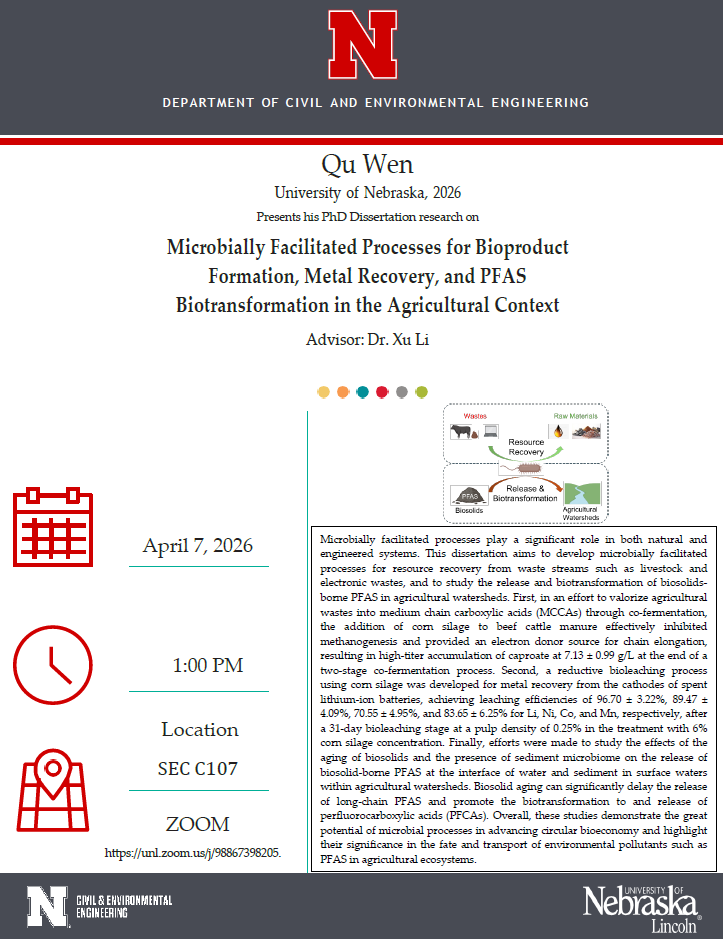
Abstract: Microbially facilitated processes play a significant role in both natural and engineered systems. This dissertation aims to develop microbially facilitated processes for resource recovery from waste streams such as livestock and electronic wastes, and to study the release and biotransformation of biosolids-borne PFAS in agricultural watersheds. First, in an effort to valorize agricultural wastes into medium chain carboxylic acids (MCCAs) through co-fermentation, the addition of corn silage to beef cattle manure effectively inhibited methanogenesis and provided an electron donor source for chain elongation, resulting in high-titer accumulation of caproate at 7.13 ± 0.99 g/L at the end of a two-stage co-fermentation process. Second, a reductive bioleaching process using corn silage was developed for metal recovery from the cathodes of spent lithium-ion batteries, achieving leaching efficiencies of 96.70 ± 3.22%, 89.47 ± 4.09%, 70.55 ± 4.95%, and 83.65 ± 6.25% for Li, Ni, Co, and Mn, respectively, after a 31-day bioleaching stage at a pulp density of 0.25% in the treatment with 6% corn silage concentration. Finally, efforts were made to study the effects of the aging of biosolids and the presence of sediment microbiome on the release of biosolid borne PFAS at the interface of water and sediment in surface waters within agricultural watersheds. Biosolid aging can significantly delay the release of long chain PFAS and promote the biotransformation to and release of perfluorocarboxylic acids (PFCAs). Overall, these studies demonstrate the great potential of microbial processes in advancing circular bioeconomy and highlight their significance in the fate and transport of environmental pollutants such as PFAS in agricultural ecosystems.