There are so many remarkable NCESR success stories to share that we continue to feature these inspiring accounts from our faculty and students in place of the traditional Director’s Corner article.
With nearly two decades of sustained funding support from NPPD, NCESR has been a catalyst for impactful research seed funding in the energy sciences. This longstanding partnership has enabled NCESR to provide critical seed funding that has supported numerous UNL faculty members, created valuable opportunities for students, and led to a strong record of publications and citations. Most notably, the return on investment has been exceptional—with every $1 of NCESR seed funding generating an impressive $8.44 in external research funding.
We are proud of these achievements and look forward to the future. NCESR is preparing the Cycle 21 RFP for seed funding, continuing our commitment to advancing energy research and innovation.
Nicole Buan (PI), Professor, Department of Biochemistry
National Science Foundation - Dynamics of carbon and energy fluxes in methanogenic archaea ($1,087,895)
Did you know that much of the energy you use comes from tiny microbes? Methanoarchaea are single-celled microbes that grow by making methane gas (CH4). They evolved more than 3 billion years ago and helped produce the natural gas that we use for electricity, heat, and fuel. We also use methanoarchaea in anaerobic digesters to make biogas from agricultural and industrial waste while cleaning the water supply. Biogas can then be upgraded and pumped into the natural gas grid or liquefied and used as rocket fuel. It has been estimated that biogas could replace the need for fossil natural gas or effectively double the US methane energy output. The US Department of Energy has estimated that biogas could produce up to 35 billion gasoline gallon equivalents of transportation fuel annually.
Although methanoarchaea are indisputably important for US energy, little is known about how methanoarchaea function at the molecular level. Only a handful of laboratories worldwide can engineer methanoarchaea, making it challenging to study how to control their metabolism to increase biogas production for fuel or decrease methane production in the cattle rumen. The Buan Lab at the University of Nebraska-Lincoln was recently awarded a $1M grant from the National Science Foundation to study protein interactions in methanoarchaea to better understand how they control growth and methane synthesis. Dr. Nicole Buan and her team will use molecular, biochemical, and computational techniques, including the newly established Cryo-Electron Microscopy Core Facility at UNL, to investigate how protein enzymes interact to pass carbon atoms and electrons between them to build a better model of the intracellular “circuitry” within these tiny microbes.
This research will lead to a better understanding of how methanogenic archaea function in natural environments and, in the future, may be used to increase the supply of renewable methane fuel or high-value chemicals to meet Nebraska’s growing energy and manufacturing needs. Buan Lab methanoarchaea research has resulted in numerous academic publications, patents, and research presentations made possible by NCESR seed grants and student support via the Darrell J. Nelson Summer Undergraduate Internship in Energy Sciences Research program, as well as by NSF, NIH, USDA and DOE funding.
“We are very excited to have this opportunity to pursue cutting-edge bioenergy research here in Nebraska. My students, colleagues and I hope our work will contribute to sustainable and resilient industries in Nebraska. Because energy is foundational to the future bioeconomy, we hope methanorchaea research will one day result in increased health, prosperity, and decreased energy prices for all Nebraskans.”
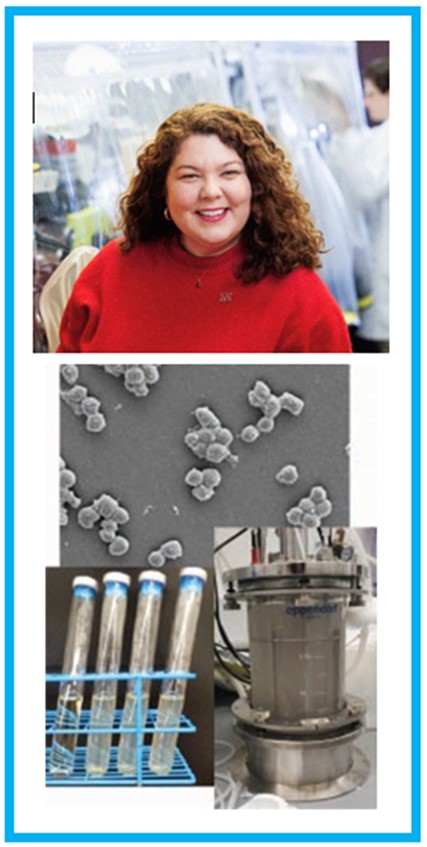
Caption for bottom photo with three images: Top image - Methanoarchaea cells viewed under scanning electron microscopy (Image taken in the UNL Morrison Microscopy Core Facility by Dr. Joe Zhou and NCESR intern Laura Kirshenbaum). The cells shown are approximately 0.8-1.6 micrometer in diameter. Right image - Methanoarchaea cells growing in a bioreactor in culture medium containing methanol, salt, and trace minerals without oxygen. Left image - Methanoarchaea are often studied in sealed glass culture tubes where growth is measured by the cloudiness of the culture.