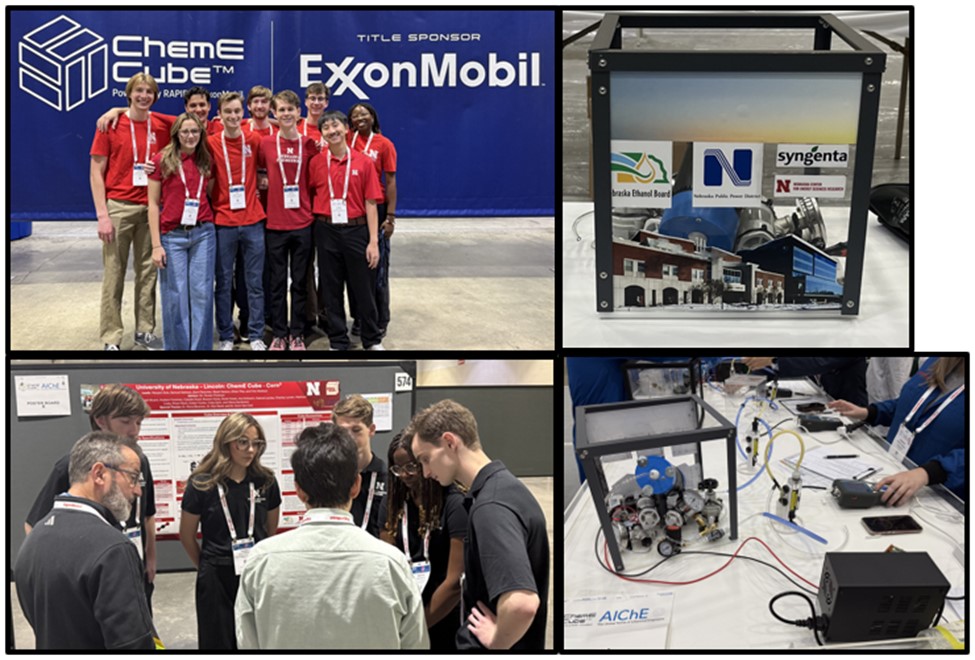
As conversations around climate change and rising atmospheric CO₂ continue to grow, chemical engineering students at the University of Nebraska–Lincoln are continuing their work to develop solutions that are both technically sound and grounded in real-world impact. For the second consecutive year, UNL’s American Institute of Chemical Engineers (AIChE) student chapter formed a ChemE Cube team to compete in the national ChemE Cube competition.
ChemE Cube challenges teams to design, build and present a one-cubic-foot device that performs a chemical process. The 2025 competition focused on Direct Air Capture (DAC) using adsorption and regeneration, with an emphasis on sustainability and feasibility beyond the lab. Building on lessons learned from last year’s competition, the team began work early by recruiting members and refining a concept that balanced technical performance with practical implementation. This year’s ChemE Cube team was led by co-captains Maryam Sule and Samuel Vadnais, with Zach Fleischer serving as design lead, Fritz Wolfram as finance lead, Wyatt Nelson as sustainability lead, and Ethan Thai as advertisement lead, alongside a team of 20 multidisciplinary engineering students.
Throughout the design process, the team moved beyond the fundamentals of CO₂ adsorption and mass transfer. They also considered scale-up, economic feasibility and long-term sustainability. In addition to building and testing the cube, the competition required teams to develop a technical poster, a business pitch and a video advertisement. These deliverables encouraged students to connect engineering design with communication and industry relevance.
In true Nebraska fashion, the team’s design centered on an amine-functionalized activated carbon derived from agricultural byproducts such as corn stover. This approach leveraged Nebraska’s agricultural strengths while offering a lower-cost and more sustainable pathway for carbon capture. The team also explored integrating this technology into existing ethanol production facilities across the state. This application served as a case study in their business pitch to demonstrate potential impact and scalability.
At the AIChE National Conference in Boston, the ChemE Cube team presented their work alongside teams from universities across the country. Through poster sessions, design evaluations and competition duels, team members shared their design, received feedback from judges, and engaged with industry professionals from ExxonMobil and RAPID as well as fellow students. Competing for a second year allowed the team to apply prior feedback and approach the competition with greater confidence. The team placed 12th out of 23 international teams overall and earned 5th place in the business pitch competition.
Beyond competition results, the team gained valuable experience in interdisciplinary problem-solving and professional communication. Connecting technical design to broader economic and environmental contexts reinforced the role chemical engineers play in addressing complex sustainability challenges.
Following the competition, the ChemE Cube team continues to reflect on lessons learned and share their work through outreach efforts. The team is excited to build on two years of experience and continue strengthening the ChemE Cube program at UNL. The team would like to give special recognition to the team advisors, Dr. Hunter Flodman, Dr. Kevin Van Cott, Dr. Mona Bavarian, and Dr. Ravi Saraf, as well as to their generous sponsors: Nebraska Public Power District (NPPD), the Nebraska Center for Energy Sciences Research (NCESR), Syngenta, and the Nebraska Ethanol board.