By Ronica Stromberg
The Center for Advanced Land Management Information Technologies at the University of Nebraska–Lincoln now offers cities and towns low-cost maps of their tree canopies.
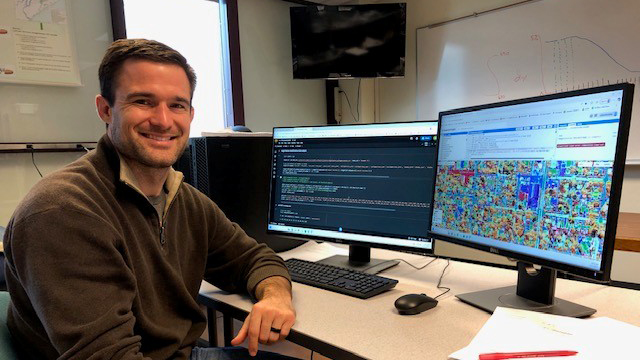
Hugh Ellerman, the scientist making the maps, said cities making these maps on their own might pay $40,000 or more, but he estimates he can make them for under $10,000 for most Nebraska cities. He developed the less expensive way to create tree maps using free aerial imagery from the USDA’s National Agriculture Imagery Program, satellite imagery and geospatial datasets.
Ellerman developed the mapping methodology as a doctoral student while funded by the Nebraska Environmental Trust to help cities and towns manage their tree populations more affordably. Cities have limited budgets to plant and remove trees on public property, like in parks, around public buildings and between sidewalks and roads.
“Tree management is a huge cost and also a huge liability if you don't do it, because if there's a rotting tree that you don't take down that's publicly owned and then it falls on someone's house, that's a cost to the city,” Ellerman said. “So, there are proactive management costs in terms of just avoiding the troubles of not managing trees, and then there are benefits just to having trees in the first place.”
Trees benefit human and animal health by filtering air pollution, buffering noise and lowering temperatures and stress levels, he said. They can also increase property values, help prevent flooding by taking in rainfall, save energy costs and provide habitat for birds and other wildlife.
Ellerman said research prior to his showed tree coverage had gone down in Nebraska cities and towns, primarily because of housing developments, storms, the old age of existing trees and the emerald ash borer, an insect that kills ash trees.
The maps he produces use a 60-centimeter scale and show trees not included in city inventories.
“Having tree maps gives you information you can't get out of tree inventories managed by the city, because the city only has access to what's publicly available, so what's visible from public roadways, which means they can't access private properties,” Ellerman said. “They can't really get into parks either, because usually their method for doing surveys is from inside a car, driving up and then marking GPS locations for trees around whatever municipality they're doing.”
His maps allow cities to see backyard trees and, with that information, fill in gaps in tree inventories. He can create the maps every two years in Nebraska, based on the National Agriculture Imagery Program’s imagery released at intervals varying by state. Cities interested in maps on a recurring schedule can view change over time in their tree canopies, identify areas to prioritize and allocate resources based on that. Cities can also obtain maps going back to the early 2000s, when the USDA program began imaging land from airplanes.
While testing his methodology as a doctoral student, Ellerman produced tree canopy maps for Lincoln, Sioux City and Waverly, Nebraska. He published the code for his method online so cities could use it freely.
His doctoral advisor, Brian Wardlow, the director of CALMIT at the university, said he was unaware of any cities using the method on their own and they might lack the expertise.
“It's not just plug and play. You don't click a couple buttons,” Wardlow said. “I would guess that most communities wouldn't actually apply the methodology themselves. They may want CALMIT to produce the maps for them.”
For small towns that want to partner with the university to make the maps instead of trying to make them themselves, he suggested they join with other small towns and approach CALMIT as a group to have maps made most affordably. Another possibility might be to work with a state agency, like the Nebraska Forest Service, and apply for a federal grant to expand the mapping effort throughout the state.
If cities start using the tree maps, Ellerman said the next step for CALMIT could be to map trees by species. Such maps would require hyperspectral data and be more expensive and labor intensive to make, but they would also give more information for planning. With them, cities could see such differences as what homeowners plant compared with what cities plant and where trees of vulnerable species are planted versus where hardy trees are planted or needed.
Cities or towns interested in learning more about tree maps can view the website at https://storymaps.arcgis.com/stories/e4d5c0082bd0474dbad1541c24827e88 or contact
Hugh Ellerman (hellerman2@unl.edu) or Brian Wardlow (bwardlow2@unl.edu) at the university with questions or requests for estimates.