By Ronica Stromberg
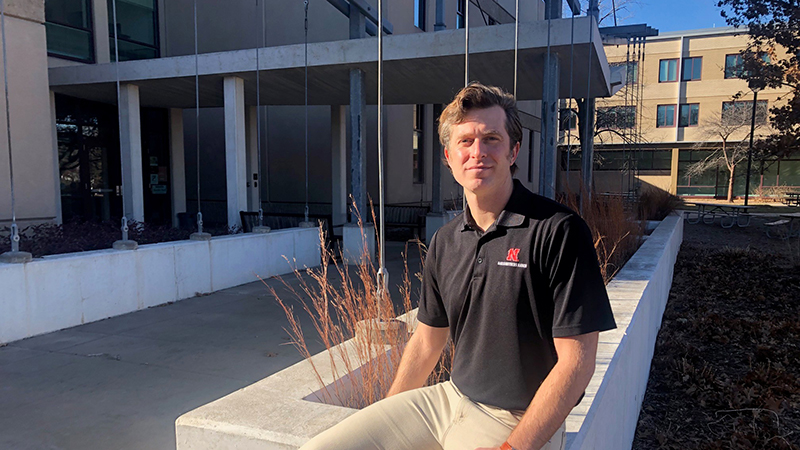
Daniel Uden stepped into the role of interim director of the Center for Resilience in Agricultural Working Landscapes at the University of Nebraska–Lincoln in January 2026.
An assistant professor in the School of Natural Resources and the Department of Agronomy and Horticulture, Uden replaces Craig Allen, who retired after founding the center and directing it four years.
Previously, Uden served on the center team as a resilience spatial scientist. He had earned both of his graduate degrees in natural resources from Nebraska, with Allen serving as his advisor. He grew up on a farm near Wood River, gaining knowledge of agriculture that has helped him in building resilience in agricultural landscapes, work he plans to continue with the center.
“I think I have a broad perspective that I hope will make me successful in understanding and contributing to those landscapes and helping the people that manage them,” Uden said.
His center work has involved developing tools to help ranchers, farmers and land managers manage their land resiliently. He uses technologies like GPS, remote sensing and geographic information systems.
The center is small, with only three permanent team members, about 10 graduate students and Allen potentially serving in an emeritus role. Still, Uden said it has a broad footprint.
“Even though we're small in number, I think our impacts are multiplied when we work with centers like the Center for Grassland Studies or CALMIT or the Center for Agricultural Profitability,” he said. “Continuing those collaborations is something I'm excited to do. I think strategically partnering with other centers is a good recipe for success for us.”
Center team members have been researching the effects of different ways to manage rangeland at the university’s Barta Brothers Ranch. Started by Allen and Walter Schacht, who formerly directed the Center for Grassland Studies, this project is a partnership between departments and centers.
Uden, Allen and Gwendŵr Meredith from the center have been partnering with professors from the Beef Innovation hub in one of the university’s Grand Challenges grants, Advancing Development of Assessments, Practices and Tools to Produce Climate Smart Beef in Grazing Systems.
Uden also serves on a project investigating how the Conservation Reserve Program affects water resources in irrigated landscapes. He works with Andy Little and the AWESM Lab on a project to sustain ringneck pheasant populations in Nebraska. He has been exploring digital agriculture in a new project with the Department of Biological Systems Engineering and the Department of Agronomy and Horticulture.
Most recently, he joined the Central Flyway Resilience Collaborative started by Larkin Powell, director of the School of Natural Resources, in August to foster resilience in the Central Flyway used by migratory birds.
Powell said Uden is a good fit for the center director role because he has a remarkable ability to work alongside people making decisions on the land and to apply spatial research there.
“His brand of collaborative leadership is exactly what CRAWL needs as it looks to the future,” he said.
The center adds an important perspective to collaborations with other centers, departments and outside agencies with its basis in and focus on ecological resilience theory, Uden said.
“One of the big things that we bring is an emphasis on the ecosystem that supports production systems, whether it's animal agriculture or crop production,” he said.
For example, the center has been looking at how plant diversity in grasslands might better sustain cattle and wildlife and how land conservation practices can help conserve water resources that support crops.
Uden said scientists have lacked opportunities to test ecological resilience theory, so the center plays an important role in doing so and contributing to the body of resilience theory through projects.
While he focuses on contributing in spatial science, Gwendŵr Meredith focuses on social science, studying the human dimensions of projects. She stated plans to continue contributing to research and grant development, supporting interdisciplinary projects and engaging with stakeholders across working landscapes. She said she was excited to hear Uden named interim director.
“Dan is a thoughtful, steady leader who is deeply committed to CRAWL’s mission,” she said. “I think his collaborative spirit and deep engagement with resilience research make him exceptionally well suited for this role.”
Uden is a young professor at 38 years and has much to focus on as he goes up for promotion and tenure this spring. He is developing classes, proposing and carrying out research projects and, now, putting much thought toward strategic directions of the center. Still, he said he has had great administrators and supervisors to learn from as role models.
“So, yeah, I'm young, I'm also early in my career, and there's a lot of things to focus on, but I'm excited for this growth opportunity and in this interim role to contribute to the center's success long-term,” he said.
He plans to include the graduate students and technicians he oversees in the center and its collaborations, giving them a cohesive identity, he said.
“I'm very passionate about collaboration, whether it's in research or teaching or any of the university's missions,” he said. “I think we maximize our impact by working together.”