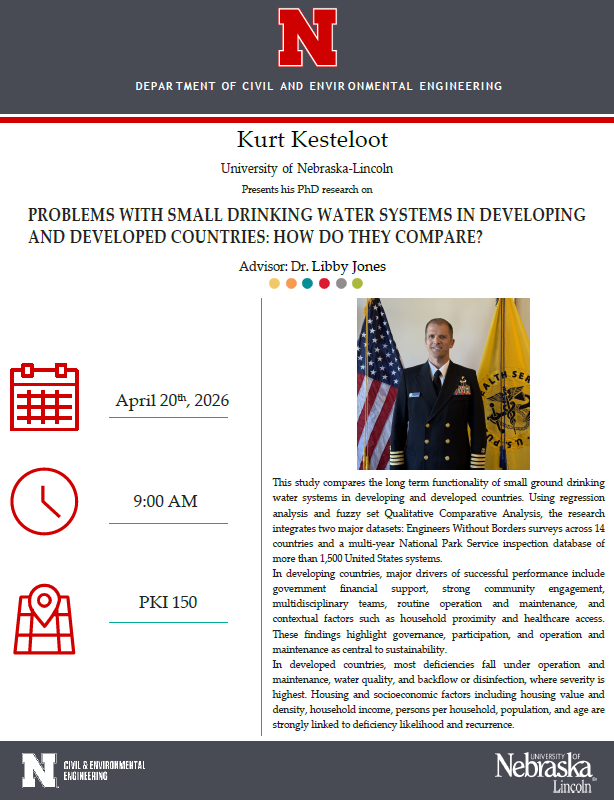
Scholar: Kurt Kesteloot
When: April 20th, 2026, 9:00AM
Where: PKI 150
Title: PROBLEMS WITH SMALL DRINKING WATER SYSTEMS IN DEVELOPING AND DEVELOPED COUNTRIES: HOW DO THEY COMPARE?
Abstract: This study compares the long term functionality of small ground drinking water systems in developing and developed countries. Using regression analysis and fuzzy set Qualitative Comparative Analysis, the research integrates two major datasets: Engineers Without Borders surveys across 14 countries and a multi-year National Park Service inspection database of more than 1,500 United States systems.
In developing countries, major drivers of successful performance include government financial support, strong community engagement, multidisciplinary teams, routine operation and maintenance, and contextual factors such as household proximity and healthcare access. These findings highlight governance, participation, and operation and maintenance as central to sustainability.
In developed countries, most deficiencies fall under operation and maintenance, water quality, and backflow or disinfection, where severity is highest. Housing and socioeconomic factors including housing value and density, household income, persons per household, population, and age are strongly linked to deficiency likelihood and recurrence