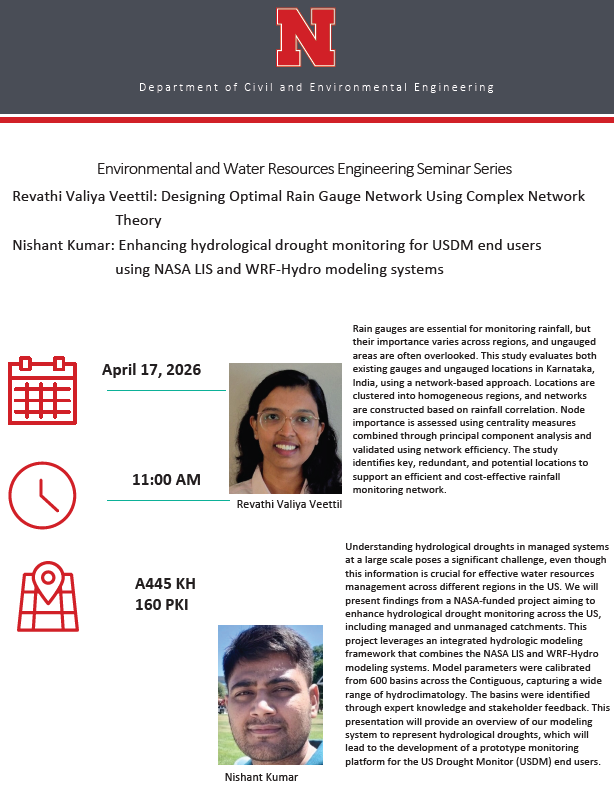
Speakers: Revathi Valiya Veettil and Nishant Kumar
When: April 17th, 2026, 11:00AM
Where: KH A445 and PKI 160
Revathi Valiya Veettil: Designing Optimal Rain Gauge Network Using Complex Network Theory
Abstract: Rain gauges are essential for monitoring rainfall, but their importance varies across regions, and ungauged areas are often overlooked. This study evaluates both existing gauges and ungauged locations in Karnataka, India, using a network-based approach. Locations are clustered into homogeneous regions, and networks are constructed based on rainfall correlation. Node importance is assessed using centrality measures combined through principal component analysis and validated using network efficiency. The study identifies key, redundant, and potential locations to support an efficient and cost-effective rainfall monitoring network.
Nishant Kumar: Enhancing hydrological drought monitoring for USDM end users
using NASA LIS and WRF-Hydro modeling systems
Abstract: Understanding hydrological droughts in managed systems at a large scale poses a significant challenge, even though this information is crucial for effective water resources management across different regions in the US. We will present findings from a NASA-funded project aiming to enhance hydrological drought monitoring across the US, including managed and unmanaged catchments. This project leverages an integrated hydrologic modeling framework that combines the NASA LIS and WRF-Hydro modeling systems. Model parameters were calibrated from 600 basins across the Contiguous, capturing a wide range of hydroclimatology. The basins were identified through expert knowledge and stakeholder feedback. This presentation will provide an overview of our modeling system to represent hydrological droughts, which will
lead to the development of a prototype monitoring platform for the US Drought Monitor (USDM) end users.