Time: 9:30 AM - 10:20 AM
Date: Tuesday, April 21
Location: Kiewit Hall, Room A249
Zoom: https://unl.zoom.us/j/92800059234 (for passive listening only)
Duration: One 50-minute class period
Title: Interdisciplinary Perspectives on Tornadoes: Forecasting, Damage Assessment, and Response
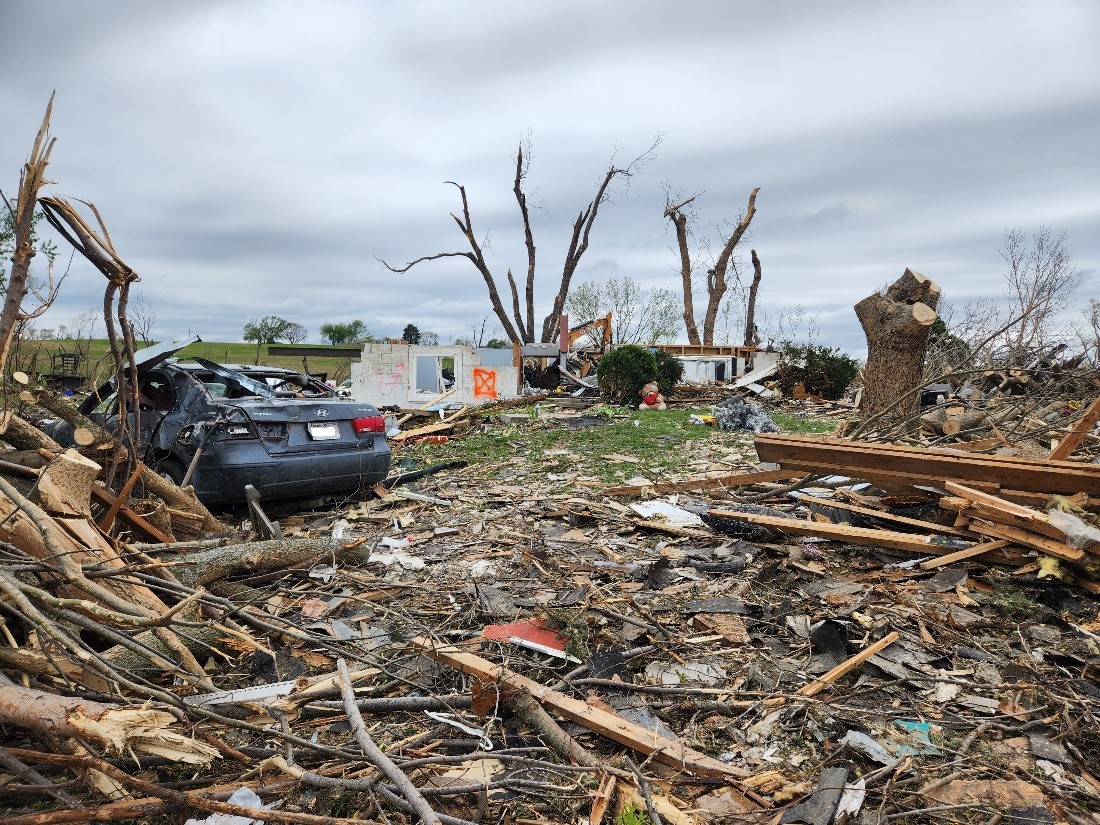
Abstract: This discussion introduces how tornadoes form, how they are monitored, and how their impacts are assessed in practice. Speakers from the National Weather Service will share real-world experiences, including the April 26, 2024 outbreak in Nebraska and Iowa, and will describe how damage surveys are conducted and how decisions are made during and after severe weather events. The session will highlight what occurs both in the forecast office and in the field, along with the associated challenges. Connections to tools such as drones and remote sensing will also be introduced to show how engineers and meteorologists collaborate to assess damage and improve understanding of severe weather.
Speakers and Biographies:
Michael Moritz – Warning Coordination Meteorologist, National Weather Service (Hastings, NE)
Michael Moritz is the Warning Coordination Meteorologist at the National Weather Service office in Hastings, Nebraska. He holds a B.S. in Meteorology from University of Nebraska–Lincoln. His work focuses on severe weather forecasting, decision support, and communication of weather hazards to support public safety. He is an active member of the ASCE 83 Committee on Wind Speed Estimation in Tornadoes, a joint standard developed by the American Society of Civil Engineers and the American Meteorological Society.
Brian Barjenbruch – Science and Operations Officer, National Weather Service (Omaha/Valley, NE)
Brian Barjenbruch is the Science and Operations Officer at the National Weather Service office in Valley, Nebraska. He holds both a B.S. and an M.S. in Meteorology from the University of Nebraska–Lincoln. His responsibilities include oversight of forecast operations, integration of new science and technology, and support for severe weather analysis and operational decision-making. He was directly involved in field response and damage assessment following the April 26, 2024 tornado outbreak that impacted Nebraska and Iowa.
Attendees are welcome to submit questions in advance, or during the presentations, using the following form:
https://go.unl.edu/cive102_tornadoes
Submissions received prior to the end of the discussion will be incorporated as time allows. Any general questions about the session, please direct them to Dr. Richard Wood, rwood@unl.edu.