By Wendy M. Smith, MTEP 2.0 co-principal investigator
Relatively few of us were trained in non-traditional research methods, particularly related to how to tell our stories effectively. Although many of us default to wanting to use data and provide evidence and arguments to support generalizable claims, what often has the power to sway administrators (and those who control resources) is stories (n=1).
To help your networked improvement community think about an interesting way to tell you story, we invite you to engage in the following exercise:
- Sketch or find on the internet an image that represents your work with your NIC.
- Jot down some thoughts about what the image represents and what emotions the image evokes or represents for you.
- Have a NIC-wide (or small group) discussion where people share their images and reflections.
- Collectively consider how these images tell part of the story of your NIC.
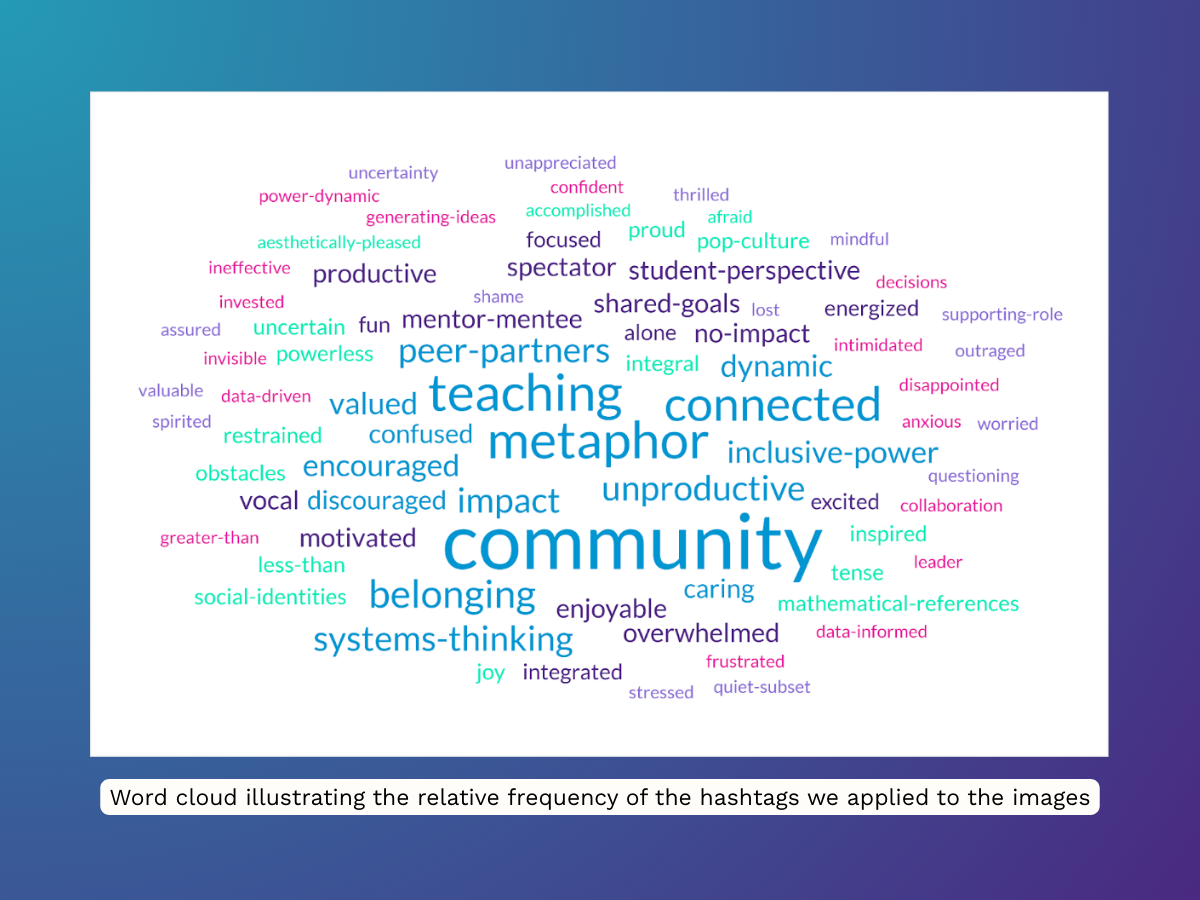
On the research side, we wanted to explore the utility of imagery in representing equity-focused work. We included an exploration of the images in our interview protocol, then coded the images and transcripts of the responses. We look at the overall themes depicted, what metaphors were shared, and what emotions were implicit and explicit in the images and explanations. We initially tagged image type: hand-drawn/created images, photographs, found/internet images, AI generated images, single images vs. collages and instances of “no image” where participants described images but did not share them. However, we later realized that the origin of the images was the least interesting aspect of this work.
The image attached to this article is a word cloud of our codes of the images and descriptions provided by participants. It may be unsurprising that the most frequently depicted or mentioned term was about NICs communities. Many participants also described features of their images that represented equity/transformation work as a journey or ongoing process. We also noted many images depicted relative positionality of members within NICs (such as being on the fringes, or being core members). We saw a variety of emotions expressed; when participants expressed strong feelings of belonging in their NICs/communities, they also tended to express more emotions with positive connotations.
Using images and their descriptions provides interesting insights into what it means to engage in critical transformation work. The images collectively suggest that people engaged in transformation efforts and NICs should expect uncertainty, confusion, and tensions. Change isn’t easy or simple; expecting to encounter barriers can help NICs plan for how to detour around or remove those barriers.
Participants collectively identified the central importance of community to sustain engagement in transformational work; changing systems cannot be done alone, and feeling supported as part of a community can help people collectively handle setbacks. Some participants discussed varying energy levels available for engaging in transformation work, citing the importance of knowing how much energy one can commit to change efforts across time. Avoiding burnout requires people to pay attention to what energizes them (such as being in community with each other).
Looking more broadly at images and their utility, we found that images can convey complexity and nuance, which is important when engaging in (systemic) transformation efforts. Some mathematicians mentioned feeling challenged to create or determine imagery, but all communicated finding value in this task and the accompanying reflections entailed. Finally, the image exploration helped people reflect on how emotions and perceived power dynamics are intertwined: when people felt more empowered to make changes and were seeing progress together, they also expressed more positive feelings associated with their transformation work.
Thus, we encourage you to engage in this imagery exercise to help tell the story of your NIC. If you want support in trying this activity, please reach out to your NIC’s coach. Using images can help convey the complexity and tensions entailed in your NIC’s work, and provide you with metaphors to communicate your story to wider audiences. Some further reading may also be helpful:
- Lieberman, D. (December 2024). The Power of Personal Storytelling in Higher Education Leadership. Higher Education Today. https://www.higheredtoday.org/2024/12/02/the-power-of-personal-storytelling/
- Quaisley, K., Smith, W. M., Voigt, M., Callahan, K. M., Sisneros-Thiry, S., & Viel, S. (2026). Visualizing the Work of Critical Transformations: Processes, Positions, and Emotions. Proceedings of the Conference on Research in Undergraduate Mathematics Education. [URL coming soon]