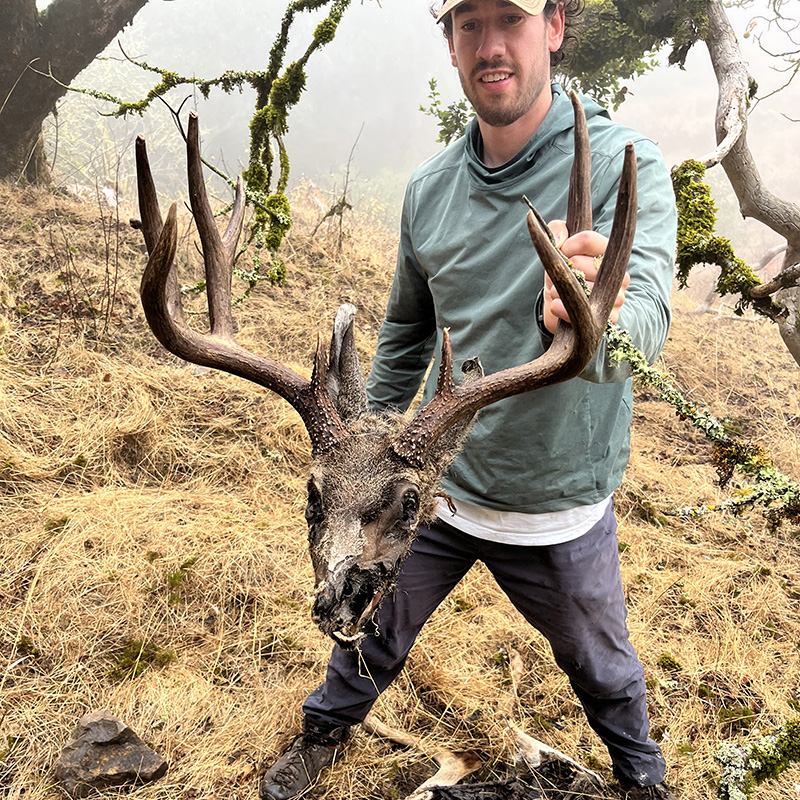
Jake Harvey graduated with MS in Natural Resource Sciences with specialization in Applied Ecology on December 20, 2025. He continues on as a candidate for his PhD here at SNR.
Jake studies lions, just not the lions on the African plains! Instead he investigates how mountain lions and people co-exist in California’s San Franciso North Bay. Although many of the people who live in the area Jake studies have never seen a mountain lion, Jake has! So have the many black-tailed deer the lions ate!! He discovered fascinating details about how this apex predator almost literally tip-toes in and around dwellings. In fact, it might be best if the local people didn’t see them! In Jake’s own words, “Our work highlights the remarkable overlap between humans and mountain lions in the North Bay, showing that these elusive cats are highly adaptable as they move and choose space amongst people - while remaining consistent in their need to hunt wild prey and survive.”
Perfect Pairing? How Mountain Lions and Humans Share the Landscape in California’s Wine Country
Most people in California’s San Francisco North Bay will never lock eyes with a mountain lion. Yet every night, just beyond the glow of porch lights, passing cars, and rows of some of the most valuable wine grapes in the world, these big cats are making careful choices about when and where to move and hunt in a landscape shared with people. By tracking mountain lions across the region, we discovered that males and females navigate this landscape in different ways. Males typically roamed over much larger areas than females, but in the most developed places their ranges actually shrank, likely because towns and roads limited freedom of movement. Females, however, were better able to meet their needs without being squeezed into smaller spaces. Despite living so close to people, both males and females mostly ate deer, much like mountain lions in more remote areas. Together, these findings provide the first full picture of how mountain lions make a living in the North Bay and the challenges they face in doing so.
We then took a closer look at how mountain lions hunted along the edge of towns and neighborhoods, questioning if human disturbance could change the rules of the game. By identifying nearly 500 locations where they killed and consumed black-tailed deer, we found that the cats favored places where deer were easiest to catch over areas where they were most abundant. However, when they could have it both ways – they did, in that mountain lions most strongly preferred areas that offered both ample hiding cover and plenty of prey, where hunting success should be highest. Occasionally, mountain lions even used fences to corner deer, showing that while human structures often negatively impact wildlife, they may occasionally give predators a hunting advantage. Lions often fed close to neighborhoods but did not consistently avoid or seek out human development. Together, these findings reveal how mountain lions balance stealth, strategy, and opportunity in landscapes shared with people.
Finally, we explored how mountain lions navigate finding food and avoiding people from their decisions about where to settle across the landscape, to the moment-by-moment choices that shape each day. At the landscape level (big scales), mountain lions persisted in places with differing levels of human disturbance, with some settling near people and others in more natural areas. Once inside their home ranges (small scales), however, they adjusted their movements to avoid people when needed. Lions that avoided human activity when choosing a home range could move more freely within it day-to-day. Conversely, those that chose home ranges shared with people had to be more cautious within their territory. All mountain lions chose home ranges that supported plenty of deer, while their day-to-day movements focused on areas with dense cover where prey were easiest to catch. This flexibility helps explain how mountain lions persist alongside people and maintain their presence in human-dominated landscapes. Despite growing scientific interest in how large carnivores live near people, most knowledge about predator-prey relationships still comes from relatively natural places. Our work contributes to filling this knowledge gap and highlights the remarkable overlap between humans and mountain lions in the North Bay, showing that these elusive cats are highly adaptable as they move and choose space amongst people - while remaining consistent in their need to hunt wild prey and survive.
Award Guidelines
Let's be honest. Research in SNR is varied, so much so that people in some fields are not able (or willing) to learn about research in other fields because they lack the technical expertise and understanding of the jargon. The SNR Graduate Committee has approved a voluntary effort by graduate students to include lay abstracts in theses and dissertations. In most career paths, graduate students will be tasked with communicating what they do to the general public, and lay abstracts provide an excellent introduction on how to write for the non-specialist. Lay abstracts will be included on the SNR website, and viewed by donors, alumni, prospective students, and any other people interested in seeing the great research done by our graduate students.
Dr. Bob Zink (rzink2@unl.edu) will serve as Lay Abstracts Coordinator. Any interested student can send a draft to Bob and he will work with you (if needed) to bring it to a point where someone outside the field can understand the work and its significance. Only graduate students who submit their thesis or dissertation during the calendar year are eligible. Lay abstracts are due to the Coordinator via email by the date established by the University for Fall semesters. The Lay Abstracts Coordinator will appoint a committee of three faculty who do not have a student in the competition, and they will declare a "Best Lay Abstract". The winner will receive $500. Let's be honest. Research in SNR is varied, so much so that people in some fields are not able (or willing) to learn about research in other fields because they lack the technical expertise and understanding of the jargon. The SNR Graduate Committee has approved a voluntary effort by graduate students to include lay abstracts in theses and dissertations. In most career paths, graduate students will be tasked with communicating what they do to the general public, and lay abstracts provide an excellent introduction on how to write for the non-specialist. Lay abstracts will be included on the SNR website, and viewed by donors, alumni, prospective students, and any other people interested in seeing the great research done by our graduate students.
Dr. Bob Zink (rzink2@unl.edu) will serve as Lay Abstracts Coordinator. Any interested student can send a draft to Bob and he will work with you (if needed) to bring it to a point where someone outside the field can understand the work and its significance. Only graduate students who submit their thesis or dissertation during the calendar year are eligible. Lay abstracts are due to the Coordinator via email by the date established by the University for Fall semesters. The Lay Abstracts Coordinator will appoint a committee of three faculty who do not have a student in the competition, and they will declare a "Best Lay Abstract". The winner will receive $500.
More details at: https://snr.unl.edu/employeeinfo/information/employeehandbook-single.aspx?hid=348