By John Nelson, Water and Cropping Systems Extension Educator in Lancaster County
The Nebraska On-Farm Research Network (NOFRN) is a collaborative research program designed to be “by farmers, for farmers.” It bridges the gap between academic research and real-world application by partnering Nebraska Extension faculty with local producers to conduct applied research on farmers’ land across the state.
NOFRN conducts 80 to 100 on-farm studies each year to find solutions to critical crop production and profitability concerns. Topics include water, nutrient and soil management, crop protection and cover crops.
2025 STUDIES
In the 2025 season, 11 On-Farm Research projects were conducted in cooperation with Nebraska Extension Water and Cropping Systems Educators John Nelson, Ritika Lamichhane, Matheus Ribeiro and Mailson Freire de Oliveira in Southeast Nebraska, including the counties of Lancaster, Cass and Saline. Here is a summary of two studies.
Fungicide Applications in Corn — One of the key studies in 2025 was comparing the efficacy of fixed-wing airplane and spray drone fungicide applications in corn. Veltyma fungicide was applied during tasseling at a rate of 7 oz/acre, with a carrier volume of 2 gal/acre. This study, conducted in eastern Cass County under severe Southern Rust disease pressure, showed no statistically significant yield differences between the two fungicide application methods (Table 1). Because of the heavy disease pressure on corn in the region, both fungicide applications significantly improved corn yield (15–19 bu/acre) over the untreated check.
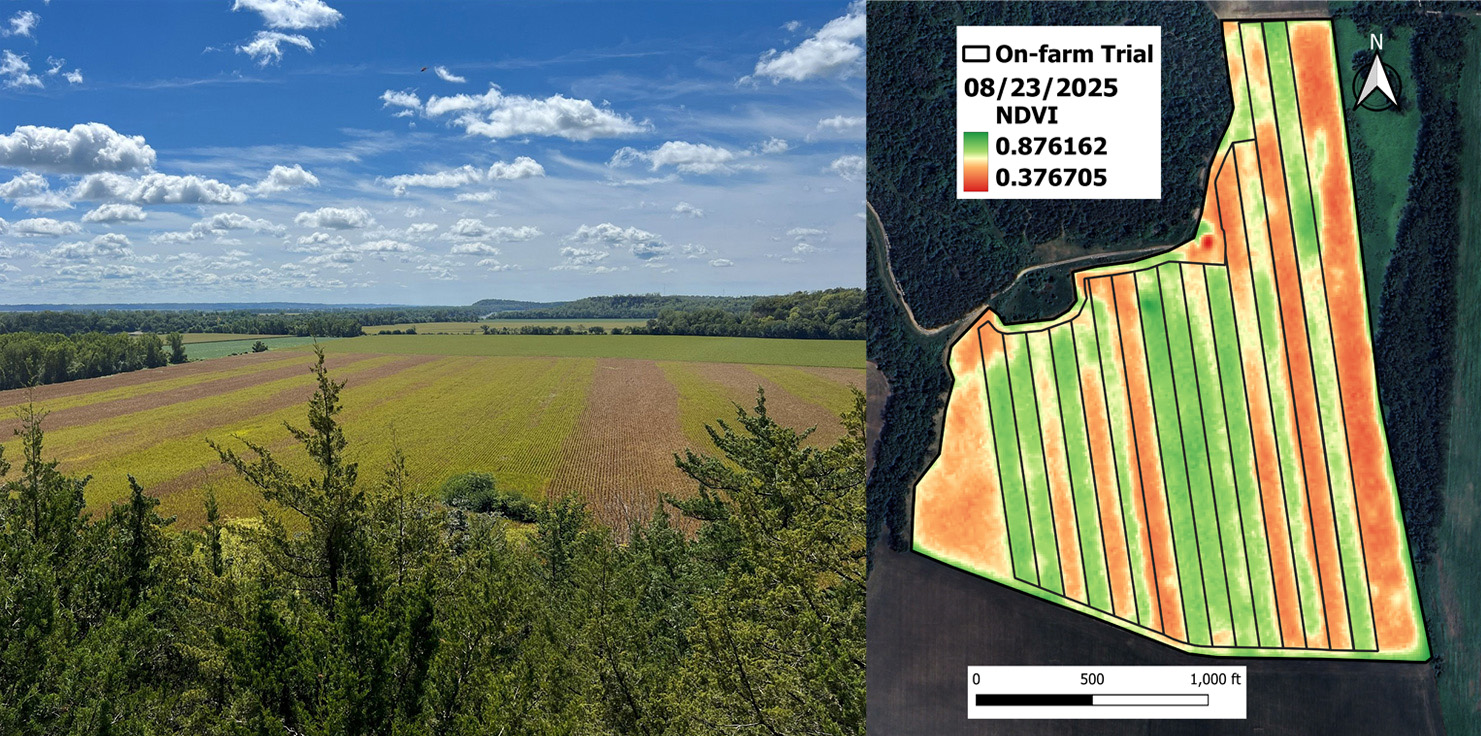
Highboy Cover Crop Interseeding Project — A long-term research study of a statewide effort aimed at understanding the benefits of preharvest cover crop seeding in corn. One site involved in the project was a dryland field in northwest Lancaster County. At this site, three different seeding rates (70 lb/acre, 140 lb/acre, 210 lb/acre) were broadcast to determine optimal practices for this system in a dryland setting.
Cover crops were first seeded in late summer of 2023, and biomass data was collected in the fall of 2023 and before planting in the spring of 2024 (Table 2). As expected, the higher seeding rates resulted in more cover crop biomass, both in the fall and spring. Additionally, the presence of cover crop reduced weed biomass compared to the plots with no cover crop.
Yield data was collected for the 2024 soybean crop that was planted into the cover crop plots. It is encouraging to see there was no statistical soybean yield effect of the 70 lb/acre cover crop seeding rate compared to the no cover crop check. However, the higher seeding rates (140 and 210 lb/acre) that produced significantly more cover crop biomass did lower soybean yield when compared to the no cover crop and 70 lb/acre seeding rate treatments.
SEEKING COLLABORATORS
If you have questions you want answered on your farm, reach out to Extension and we’ll help you design a study, collect data and analyze the results. If you are interested in conducting an On-Farm Research study on your field, contact your local Extension Water and Cropping Systems Educator. In Lancaster, Cass or Otoe counties, contact John Nelson at 402‑441‑7180 or jnelson158@unl.edu.
RESULTS MEETINGS
The Nebraska On-Farm Research Results Meetings are an opportunity for farmers to learn the details of the studies conducted in their region, as well as network with the producers who participated in the research. A meeting will be held on Wednesday, March 4, 9 a.m.–3 p.m. at the Kimmel Orchard Event Center in Nebraska City. Meetings are free to attend and lunch is provided. Please register at https://go.unl.edu/x2nz. Extension Educators will discuss the regional projects in detail, explain results and give cooperating producers an opportunity to share their experiences and opinions on how the research will affect their farming operations.
FOR MORE INFORMATION
Learn more about the Nebraska On-Farm Research Network and see research results at https://on-farm-research.unl.edu
___________________________________
Table 1. Grain moisture, yield and marginal net return differences between drone and airplane fungicide applications. A vs. B indicates statistically significant differences.
Airplane Treatment
Moisture (%) = 15 A
Yield (bu/acre) = 242 A
Marginal Net Return ($/acre) = 1007 A
Drone Treatment
Moisture (%) = 15 A
Yield (bu/acre) = 246 A
Marginal Net Return ($/acre) = 1023 A
Untreated
Moisture (%) = 15 A
Yield (bu/acre) = 227 B
Marginal Net Return ($/acre) = 959 B
P-Value
Moisture (%) = 0.19
Yield (bu/acre) = 0.0001
Marginal Net Return ($/acre) = 0.0005
___________________________________
Table 2. Lancaster County HiCCIP project results showing cover crop and weed biomass collected in a corn field. A vs. B indicates statistically significant differences.
70 lb/ac Seeding Rates in Corn at R5 Stage
Fall 2023 Cover Crop Biomass (lb/ac) = 350.5 A
Fall 2023 Weed Biomass (lb/ac) = 0
Spring 2024 Cover Crop Biomass (lb/ac) = 10541.9 A
Spring 2024 Weed Biomass (lb/ac) = 0
140 lb/ac Seeding Rates in Corn at R5 Stage
Fall 2023 Cover Crop Biomass (lb/ac) = 513.8 A
Fall 2023 Weed Biomass (lb/ac) = 0
Spring 2024 Cover Crop Biomass (lb/ac) = 11507.0 AB
Spring 2024 Weed Biomass (lb/ac) = 0
210 lb/ac Seeding Rates in Corn at R5 Stage
Fall 2023 Cover Crop Biomass (lb/ac) = 847.5 B
Fall 2023 Weed Biomass (lb/ac) = 0
Spring 2024 Cover Crop Biomass (lb/ac) = 12850.2 B
Spring 2024 Weed Biomass (lb/ac) = 0
Check (no cover crop)
Fall 2023 Cover Crop Biomass (lb/ac) = NA
Fall 2023 Weed Biomass (lb/ac) = 0
Spring 2024 Cover Crop Biomass (lb/ac) = NA
Spring 2024 Weed Biomass (lb/ac) = 728.6
P-Value
Fall 2023 Cover Crop Biomass (lb/ac) = 0.004
Fall 2023 Weed Biomass (lb/ac) = NA
Spring 2024 Cover Crop Biomass (lb/ac) = 0.005
Spring 2024 Weed Biomass (lb/ac) = NA